
The Master’s Guide to Sealing Marble Countertops in a Bathroom (2026)
Could a single drop of water be the silent undoing of a masterpiece that took millennia for nature to forge? You likely selected marble for its incomparable depth and the quiet prestige it lends to your home, yet the constant proximity to moisture and cosmetic chemicals often creates a lingering sense of trepidation. It’s a common burden for the discerning homeowner; the fear that a stray bottle of perfume or a damp glass might leave a permanent scar on an otherwise flawless surface. We understand that your bathroom should be a sanctuary of repose, not a gallery where you’re afraid to touch the exhibits.
This master’s guide demystifies the process of sealing marble countertops in a bathroom, replacing DIY confusion with the clarity of professional-grade methodology. You’ll discover how the latest 2026 advancements in fluoropolymer technology provide an invisible, breathable barrier that honors the stone’s organic texture while offering uncompromising protection. We’ll outline a sophisticated maintenance schedule and provide the technical confidence needed to select products that meet the most stringent environmental standards. By the end of this exploration, you’ll possess the knowledge to preserve your marble’s timeless elegance, ensuring it remains a testament to refined living for decades to come.
Key Takeaways
- Grasp the geological nuances of your stone and why the bathroom’s humid climate demands a specific preservation strategy.
- Understand the science of molecular impregnators to provide deep protection without compromising the marble’s natural ability to breathe.
- Utilize professional assessment protocols to accurately determine when your surfaces require a renewed layer of defense.
- Master the ‘Saturate and Dwell’ technique for sealing marble countertops in a bathroom to ensure the stone is thoroughly protected.
- Establish a maintenance ritual centered on pH-neutral care to prevent the chemical etching caused by standard household products.
The Vulnerability of Elegance: Why Bathroom Marble Demands Protection
Marble is a living material. Born from the slow, rhythmic pressure of the earth, this metamorphic limestone carries a history that continues to unfold within the walls of your home. It’s a common misconception to view a stone slab as an inert, impenetrable shield. In reality, marble possesses a complex network of microscopic capillaries that remain active long after the stone is quarried. When you introduce this material into a bathroom, you place it in a paradox of high humidity and persistent steam. These environmental factors don’t merely sit on the surface; they act as a catalyst, driving moisture and dissolved contaminants deep into the stone’s structure.
Understanding the distinction between a material being waterproof and being stain-proof is vital for any collector of fine stone. While marble won’t degrade when exposed to water, its porous nature means it can absorb liquids that carry pigments or oils, leading to deep-seated discoloration. Utilizing a high-quality Stone sealer is the only way to ensure these liquids remain on the surface where they can be safely cleared. This proactive care is the foundation of preserving your investment in custom countertops Staten Island, ensuring the stone’s narrative remains one of beauty rather than neglect.
To better understand the practical application of these preservation concepts, watch this helpful video regarding the ritual of stone care:
The Chemical Threat: Beyond Simple Water Stains
The modern bathroom is a site of intense chemical activity. Soaps are often alkaline, while perfumes and colognes lean toward the acidic. When these substances contact the calcium carbonate that comprises your marble, a chemical reaction occurs. This reaction is known as etching, a physical dulling of the stone’s surface that a sealer cannot always prevent. However, sealing marble countertops in a bathroom is essential for blocking the “moisturizing” oils found in high-end lotions. These oils are particularly insidious, as they settle deep within the stone’s pores and create dark, translucent shadows that are notoriously difficult to extract once they’ve set.
Defining Porosity in the Modern Bathroom
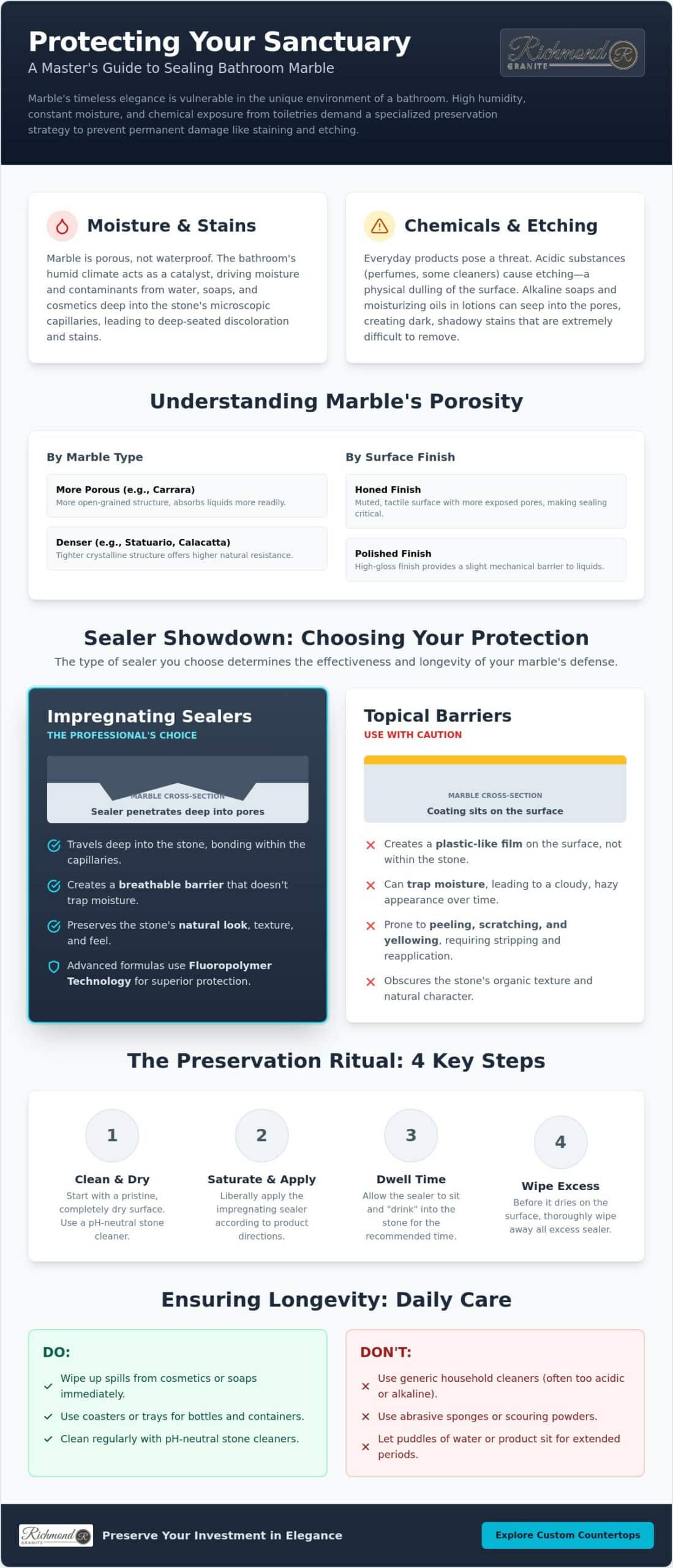
Not all marble shares the same internal architecture. The tight, crystalline structures of Statuario or Calacatta often provide a slightly higher natural resistance than the more open-grained varieties of Carrara. Furthermore, the finish you choose—whether a high-gloss polish or a muted, tactile hone—alters how the stone interacts with light and liquids. A polished surface provides a slight mechanical barrier, whereas a honed finish exposes more of the stone’s “pores,” making the sealing ritual even more urgent. Marble porosity is the measure of void spaces within the stone’s crystalline lattice. This technical reality dictates how much sealer the stone will “drink” during the application process and how often the treatment must be renewed to maintain its prestigious luster.
Decoding the Sealer: Impregnators vs. Topical Barriers
Choosing a sealer is an act of guardianship. For a master artisan, the choice is almost always an impregnating sealer over a topical one. Unlike topical coatings that create a plastic-like film on the surface, an impregnator travels into the interstitial spaces of the stone. This distinction is critical for sealing marble countertops in a bathroom. A topical barrier might offer temporary shine; however, it eventually peels or traps moisture, leading to a cloudy, unattractive finish that obscures the stone’s inherent character.
The carrier of these protective molecules, whether solvent or water, matters immensely for the final result. Solvent-based formulas often possess a lower viscosity. This allows them to penetrate the dense crystalline structures of premium marble more effectively. Water-based options have improved significantly in recent years; many now meet the stringent 100 g/L VOC limits set by the EPA for tile and stone sealers in specific regions. When sealing marble countertops in a bathroom, ensuring the formula is oleophobic is the only way to guard against the oils found in high-end cosmetics and lotions.
How Penetrating Sealers Work at a Molecular Level
High-quality sealers function like a microscopic umbrella. They don’t plug the pores; they line them. This allows the natural stone to remain breathable. If moisture becomes trapped beneath the surface, it must be allowed to escape as vapor. Without this vapor transmission, the stone’s internal structure can weaken or discolor over time. Adhering to Natural Stone Institute guidelines on sealing ensures you’re selecting a product that respects this geological necessity while providing a defense that can last for years.
The Pitfalls of Inferior ‘Big Box’ Products
Mass-market products often rely on inexpensive silicone or siloxane chemistries. While functional for a short season, these can lead to a subtle yellowing of white marble, eventually obscuring the crisp, grey veining of a fine Calacatta slab. Professional-grade fluoropolymers are the superior choice. They offer a significantly longer life expectancy and maintain the stone’s pristine aesthetic without altering its slip resistance. This commitment to chemical excellence mirrors our own approach to crafting bespoke marble surfaces that stand as legacies in the home. Selecting a professional-grade sealer is the final, essential step in the manual refinement of the natural world.
The Definitive Assessment: Is Your Marble Ready for Sealing?
Determining the precise moment for sealing marble countertops in a bathroom requires a meticulous interrogation of the stone’s current state. We move beyond the arbitrary “once a year” recommendation, favoring a needs-based schedule that respects the unique usage patterns of your sanctuary. The primary diagnostic tool is the Water Test. By placing a small pool of water on the surface and monitoring it for ten minutes, you can observe the stone’s thirst. If the water remains beaded and proud, the existing barrier is intact. However, if the stone darkens or the water disappears, the capillaries are exposed and vulnerable.
In a bathroom environment, the Water Test alone is insufficient. The presence of lotions, hair products, and essential oils necessitates the Oil Test. Placing a single drop of mineral oil in a discreet corner for fifteen minutes reveals whether your marble can repel the organic compounds common to a vanity. If a dark spot remains after blotting the oil away, your defense has been compromised. You might also notice visual cues such as a persistent darkening around faucet bases or a faint “ghosting” effect near high-steam areas like the shower. These are the stone’s silent pleas for preservation.
Recognizing Factory Resin Treatments
Many contemporary marble slabs undergo a factory resin treatment to stabilize natural fissures or enhance color depth. Identifying these treatments is essential; look for a subtle mesh backing or a glass-like smoothness in the veining that suggests a resin-fill. Over-sealing a resinated stone is a common error that results in a stubborn, hazy residue because the resin has already occupied the stone’s void spaces. Before proceeding, consult your granite fabricator near me to understand the specific geological and chemical history of your slab.
The ‘Clean Slate’ Protocol: Preparing the Surface
A successful seal begins with a surface devoid of all previous interventions. Standard bathroom cleaners often leave a microscopic film of surfactants or waxes that act as a barrier, preventing the sealer from reaching the stone’s pores. Use a specialized, residue-free stone cleaner to strip away these invisible layers. Once cleaned, the stone must reach a state of total equilibrium. We mandate a minimum of 24 hours of absolute dryness before application. Moisture trapped in the stone’s pores will prevent the sealer from achieving a proper bond. This patience ensures that when you finally begin sealing marble countertops in a bathroom, the chemical union is permanent and profound.
The Preservation Ritual: A Step-by-Step Execution
The ritual of sealing marble countertops in a bathroom begins with an environment in balance. Ensure the room is well ventilated; modern professional-grade sealers, while often lower in VOCs, still require steady airflow to facilitate the molecular bonding process. Maintain a stable temperature between 60 and 80 degrees Fahrenheit. Extreme cold or heat can disrupt the chemical carrier’s evaporation rate, leading to an uneven or incomplete seal. Precision is paramount here. A rushed application often results in a compromised finish that fails to honor the stone’s heritage.
We utilize the ‘Saturate and Dwell’ technique for sealing marble countertops in a bathroom. Apply the sealer generously until the stone maintains a “wet” look for several minutes. This dwell time, typically between three and five minutes, allows the stone to absorb the liquid into its deepest capillaries. If the sealer vanishes instantly, the stone’s thirst remains unquenched, and a second application is immediately required while the surface is still damp. The most critical step follows: the thorough removal of excess liquid. Any sealer left to dry on the surface will create a sticky, dull film that requires aggressive chemical stripping to resolve. Efficiency matters. Work with intent.
Step-by-Step: From Application to Cure
Work in manageable quadrants. By dividing your bathroom vanity into sections, you prevent the sealer from drying prematurely before you can buff the surface. Once the dwell time is complete, use a clean, lint-free microfiber cloth to buff the stone until it is completely dry to the touch. This artisan finish ensures no streaks or hazy residue remain. While the surface may feel dry within an hour, the full chemical cure requires 24 hours of absolute stillness. Avoid all contact with water or cosmetics during this window. Patience is the final ingredient.
Special Considerations for Edges and Cutouts
A master’s attention never stops at the horizontal plane. The vertical apron and the underside of any overhang require the same meticulous application to prevent moisture from traveling upward into the stone’s core. Faucet cutouts are particularly vulnerable; water often pools here, leading to ‘blossoming’ stains that radiate from the plumbing. Don’t ignore the vertical. Ensure the backsplash receives equal reverence. By treating these often overlooked areas, you create a comprehensive shield for your bespoke bathroom vanities, preserving their integrity against the daily rigors of a luxury lifestyle.
Beyond the Sealer: Ensuring the Longevity of Your Bathroom Sanctuary
The completion of the sealing ritual is not an end, but a beginning. While sealing marble countertops in a bathroom provides a vital molecular shield, the enduring grace of the stone depends on the small, deliberate actions of daily stewardship. Adopt a philosophy of “blot, don’t wipe” for every spill. When you wipe a surface, you risk driving microscopic particles into the stone’s texture or spreading a chemical contaminant across a wider area. Blotting with a soft, absorbent cloth lifts the liquid directly away, respecting the integrity of the barrier you’ve just established. This simple change in habit prevents the mechanical wear that can prematurely degrade your protective seal.
Chemical harmony is the cornerstone of stone preservation. Most standard household cleaners rely on aggressive acidity or harsh alkalinity to cut through grime. These substances are the natural enemies of calcium-based stones. They don’t just sit on the surface; they chemically attack the sealer and the marble itself, leading to the dull spots known as etching. We recommend integrating a formal stone check into your seasonal home maintenance calendar. If water no longer beads with the same vigor described in our earlier assessment protocol, it’s time to revisit the preservation ritual. Consistency is the secret to a bathroom that feels timeless.
There are moments when the limits of home care are reached. If you encounter deep etching that resists gentle cleaning, or if the stone has suffered a physical impact that compromises its structure, it’s time to consult the masters. Professional restoration, involving expert honing and polishing, can return a weathered surface to its original brilliance. Recognizing when to allow an artisan to intervene is a sign of a sophisticated homeowner who values legacy above all else. True luxury is never rushed; it’s maintained with poise.
Curating a Stone-Safe Cleaning Kit
True luxury is found in the details of care. Your cleaning kit should be a curated selection of pH-neutral solutions specifically formulated for natural stone. Many homeowners fall into the “natural” trap, assuming that vinegar or lemon juice are safe alternatives. These acidic liquids are corrosive; they will etch the marble and dissolve the protective seal almost instantly. Use soft, non-abrasive tools that protect both your stone and the finish of your custom bathroom cabinets. A dedicated microfiber cloth and a gentle, stone-specific spray are all that’s required to maintain a pristine environment.
The Richmond Stone Commitment to Excellence
We view ourselves as more than suppliers; we are the premier guardians of the elements we handle. This guide is built upon 30 years of heritage and a deep reverence for the raw materials that define your home. Our commitment to excellence ensures that every project is a unique, curated masterpiece. When we perform a professional installation, we include the first and most critical seal of the stone’s life. This initial treatment sets the high standard for everything that follows. We bridge the gap between industrial expertise and artistic vision, ensuring your bathroom remains a sanctuary of quiet confidence for decades.
Preserving the Timeless Legacy of Your Stone
The journey from raw geological element to refined architectural feature is one of meticulous care. By mastering the nuances of impregnating sealers and the “Saturate and Dwell” technique, you’ve transformed a maintenance task into a ritual of preservation. You now understand that sealing marble countertops in a bathroom isn’t about creating a plastic barrier. It’s about honoring the stone’s natural breathability while shielding its delicate capillaries from modern chemical stressors. Your commitment to pH-neutral care and proactive monitoring ensures that your sanctuary remains a masterpiece of enduring elegance.
As family-owned master artisans for over 30 years, we remain dedicated to the manual refinement of the natural world. We bring this uncompromising quality to every project across Staten Island, NYC, and New Jersey, serving as trusted partners in the creation of prestigious environments. Discover the Richmond Stone Collection and Schedule a Design Consultation to begin your next chapter in luxury living. Your marble is a testament to nature’s artistry. We’re here to ensure it remains flawless for generations.
Frequently Asked Questions
How often should I seal my marble bathroom countertops?
You should determine the frequency of care through the Water Test rather than a rigid calendar. While high-traffic vanities often require attention every six to twelve months, the durability of the barrier depends on your specific usage and the quality of your daily cleaners. If water no longer beads on the surface or if the stone darkens quickly when wet, it’s time to perform the ritual again to maintain its prestigious luster.
Can I use the same sealer for my marble and my grout?
Yes, a professional-grade impregnating sealer is typically compatible with both your marble and the surrounding grout. These formulas are designed to penetrate the capillaries of various porous materials to provide a unified shield against moisture and oils. Applying a single, high-quality product ensures consistent protection across your entire vanity or backsplash, simplifying your maintenance schedule without compromising on quality.
Will sealing my marble prevent etching from acidic products like lemon juice?
No, sealing marble countertops in a bathroom won’t prevent etching from acidic substances. Sealing acts as a defense against liquid absorption to prevent deep stains, but it doesn’t change the chemical composition of the stone. Acidic products like lemon juice or certain perfumes react with the calcium carbonate in the marble, creating a dull spot that requires professional honing to repair.
How do I know if my marble was already sealed at the factory?
You can identify a factory treatment by looking for a mesh backing or a resin-fill within the stone’s natural veins. If the surface feels exceptionally glass-like or if water beads perfectly upon initial installation, a treatment is likely present. Performing the Water Test on a new slab is the most definitive way to know if your stone is ready for its first home-applied seal.
What is the best way to remove a stain that has already set into the marble?
The most effective method for removing a set-in stain is the application of a poultice. By mixing a stone-safe cleaning agent with an absorbent powder, you create a paste that draws the contaminant out of the stone’s pores through capillary action. This process requires patience, often taking 24 to 48 hours to fully lift the shadow from the marble’s depths and restore the stone’s clarity.
Is it possible to over-seal marble, and what happens if I do?
It is indeed possible to over-seal marble, and doing so often results in a stubborn, hazy residue. When the stone’s capillaries are already saturated, any additional sealer sits on the surface and dries into a sticky film. This obscures the natural luster of the material and creates an uneven finish that may require professional stripping to resolve, so always buff away every drop of excess liquid.
Can I use vinegar or Windex on my sealed marble countertops?
You must avoid vinegar and Windex, as their chemical profiles are far too aggressive for natural stone. Vinegar is highly acidic and will etch the surface instantly, while the ammonia in many glass cleaners can degrade the protective seal over time. Stick to pH-neutral solutions that respect the stone’s geological heritage and maintain the integrity of your preservation efforts for decades to come.
How long do I have to wait to use my bathroom after sealing the vanity?
You should wait a full 24 hours before allowing moisture or cosmetics to touch the surface. While the sealer may feel dry to the touch within an hour, the molecular bonding process requires a full day to achieve a complete chemical cure. This window of stillness is essential for sealing marble countertops in a bathroom to ensure the longest possible life for your protective barrier.