
Granite vs. Quartz Countertops: A Master Artisan’s Guide to Pros and Cons (2026)
Can a single choice in material truly bridge the gap between ancient geological artistry and the rigorous demands of a contemporary home? You’ve likely spent hours weighing the granite vs quartz countertops pros and cons, caught between the allure of a slab forged over millennia and the precision of modern engineering. It’s natural to feel a sense of hesitation. You want the prestige of a high-end finish, yet you fear the permanence of a red wine stain or the potential “plastic” feel of a manufactured product.
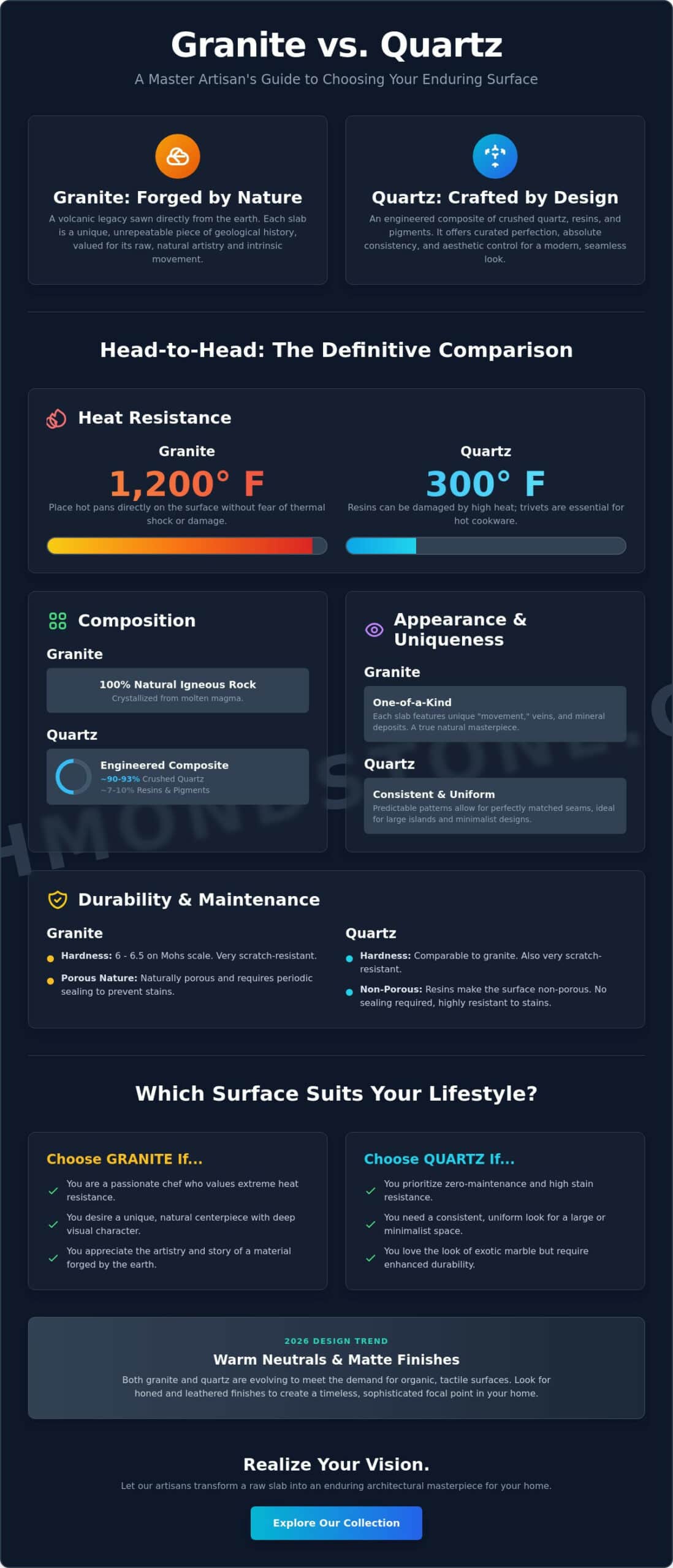
We understand that your kitchen is more than a utility; it’s a legacy. This guide provides a master artisan’s perspective on these two titans of design, ensuring you select a surface that honors your vision while standing the test of time. We’ll explore how 2026 trends like warm, organic neutrals and matte finishes intersect with technical realities, such as granite’s ability to withstand 1,200 degrees Fahrenheit compared to the heat-sensitive resins in quartz. By the end, you’ll have the clarity needed to invest with confidence and the knowledge to find a fabricator who treats your project as a unique, curated masterpiece.
Key Takeaways
- Understand the fundamental distinction between a volcanic legacy forged over millennia and a meticulously engineered composite designed for modern performance.
- Identify the specific lifestyle factors, such as high-heat culinary habits or a preference for seamless patterns, that dictate your ideal material choice.
- Evaluate the granite vs quartz countertops pros and cons through the lens of long-term durability, maintenance requirements, and aesthetic permanence.
- Learn how to navigate the 2026 shift toward organic movement and matte finishes to ensure your surfaces remain a timeless focal point.
- Discover the critical role of the fabrication lifecycle in transforming a raw slab into a curated, enduring architectural masterpiece.
The Genesis of Surface: Defining Granite and Quartz
To choose a countertop is to select the very foundation of your kitchen’s character. When examining the granite vs quartz countertops pros and cons, we must first look to their distinct origins. One is a raw testament to the earth’s ancient power; the other is a refined triumph of modern innovation. This fundamental distinction between the organic and the engineered defines not just the material’s performance, but the emotional resonance it brings to your living space.
The choice between being “sawn from the earth” and “crafted by design” dictates the personality of your home. Granite carries the weight of history, while quartz offers the poise of curated perfection. To better understand this concept, watch this helpful video:
The Geological Soul of Granite
Granite is a volcanic legacy. It’s forged over millennia deep within the earth’s crust as molten rock cools with agonizing slowness. This glacial cooling process creates the dense, interlocking crystalline structure that grants granite its legendary hardness, often measuring between 6 and 6.5 on the Mohs scale. Because it’s sawn directly from the earth in massive blocks, every slab is a singular, unrepeatable art piece.
The “movement” you see, those sweeping veins and sudden bursts of mineral color, is a literal map of geological history. No two surfaces are identical. Choosing granite means inviting a piece of the natural world’s heritage into your home, complete with the subtle variations that prove its authenticity. It is a choice for those who value the intrinsic artistry of raw, natural elements.
The Engineered Precision of Quartz
If granite is a discovery, quartz is a curation. While it contains genuine mineral content, it is a meticulously crafted composite. This Engineered Stone Composition typically consists of approximately 90% to 93% crushed natural quartz crystals bound together by high-performance polymer resins and pigments. This manufacturing process eliminates the unpredictable fissures and pores found in natural stone, resulting in a surface with absolute structural integrity.
Quartz represents the pinnacle of “crafted by design.” It allows for a level of aesthetic control that nature alone cannot provide. It’s ideal for expansive kitchen islands requiring perfectly matched seams and consistent patterns that flow across a room. Modern fabrication has evolved significantly; by 2026, quartz designs have mastered the ability to mimic the delicate veining of rare marbles and exotic stones. Understanding the granite vs quartz countertops pros and cons starts here, at the intersection of nature’s raw beauty and human precision.
The Timeless Allure of Granite: Strengths and Considerations
Granite remains the gold standard for those seeking a connection to the raw, unyielding power of the earth. When weighing the granite vs quartz countertops pros and cons, granite’s most formidable advantage is its exceptional resilience to extreme temperatures. While engineered surfaces may suffer damage at temperatures above 300 degrees, natural granite can withstand up to 1,200 degrees Fahrenheit. You can place a searing cast-iron skillet directly on its surface without the haunting fear of thermal shock or permanent discoloration. It’s a material built for the rigors of a true chef’s kitchen.
Beyond its physical toughness, there’s a visual depth that human engineering hasn’t yet replicated. The crystalline structure of the stone creates a three-dimensional quality, where light penetrates the surface and reflects off internal mineral deposits. This luminosity gives granite a “soul” that feels alive under your kitchen lighting, shifting and revealing new details as the day progresses. It’s a surface that rewards the close observer.
The Mastery of the Natural Aesthetic
Granite offers a spectrum of movement that ranges from the rhythmic, subtle speckles of a classic slab to the dramatic, flowing veins that resemble a landscape in motion. This “natural luxury” status translates directly into property value. According to the National Association of Home Builders, homeowners often see a return on investment between 60% and 80% when using genuine stone. There’s also a distinct tactile experience to consider. The stone remains naturally cool to the touch, providing a substantial, grounding presence that anchors the room’s design. Some homeowners occasionally ask about safety regarding natural minerals; for peace of mind, you can review the EPA Radon Information which confirms that these surfaces pose no significant health risk.
Navigating Maintenance and Vulnerabilities
The most common anxiety regarding granite is its porosity. It’s true that, unlike quartz, granite requires a professional-grade sealant to prevent liquid absorption. However, modern sealants have transformed this from a burden into a simple ritual, often requiring only a single application every one to three years to maintain a pristine barrier. You must still exercise caution with acidic substances. Citrus juices, vinegars, and harsh chemicals can etch the surface if left to sit, dulling the polish over time. Granite possesses a Mohs hardness rating of 6 to 6.5, providing a formidable defense against the scratches of everyday culinary life. If you’re drawn to the unrepeatable patterns found in nature, exploring a curated gallery of natural granite slabs is the first step toward defining your home’s legacy.
The Modern Sophistication of Quartz: Performance Curated
While granite represents the unrepeatable art of nature, quartz stands as a testament to the manual refinement of the natural world. In the ongoing debate regarding granite vs quartz countertops pros and cons, quartz has emerged as the premier choice for those who prioritize surgical precision and effortless maintenance. By 2026, quartz has secured 51% of the market share, largely due to its ability to marry high-end aesthetics with industrial-grade durability. It is a surface where human ingenuity eliminates the vulnerabilities of the earth, resulting in a non-porous shield that is inherently resistant to bacteria, mold, and the common stains of a vibrant household.
Unlike its natural counterpart, quartz doesn’t require the ritual of periodic sealing. The polymer resins used in its construction create a permanent barrier, ensuring that a spilled glass of Cabernet or a drop of lemon juice remains on the surface rather than becoming a permanent part of the stone’s history. For a deeper look at the scientific nuances of these materials, this Geologist’s Comparison of Quartz and Granite provides an excellent breakdown of how these surfaces differ at a molecular level. It’s a surface defined by control, offering a predictable elegance that natural stone cannot always guarantee.
A Canvas for Architectural Vision
Quartz offers a level of design consistency that is essential for modern, minimalist aesthetics. It allows for a rhythmic flow of pattern and color that doesn’t falter, regardless of the project’s scale. This predictability is particularly advantageous for:
- Seamless Integration: Achieving perfectly matched joins on expansive kitchen islands where continuity is paramount.
- Jumbo Slabs: Utilizing oversized formats to minimize visible seams in large, open-concept architectural spaces.
- Intricate Edging: Fabricating sophisticated edge profiles that remain uniform across every linear inch of the installation.
It is the ideal material for those who view their kitchen as a curated masterpiece where every detail must align with absolute precision.
Performance Realities for Busy Households
The inclusion of high-performance resins grants quartz a degree of flexibility that natural stone lacks. This translates to superior impact resistance; it’s less prone to the accidental chipping that can occur when a heavy pot meets a sharp edge. However, this same resin content introduces a specific vulnerability: heat. While granite thrives in high-temperature environments, quartz can suffer thermal shock or permanent discoloration if exposed to temperatures between 300 and 400 degrees Fahrenheit. The use of trivets isn’t a suggestion; it’s a requirement for preserving the material’s integrity. Additionally, these resins are sensitive to UV light, which makes quartz an indoor-only luxury. In a sun-drenched outdoor kitchen, the pigments may fade or yellow over time, a stark contrast to the enduring stability of natural elements handled by a master artisan.
The Comparative Analysis: Selecting Your Enduring Surface
Choosing between these two titans of design requires a synthesis of aesthetic desire and the practical realities of your daily life. When evaluating the granite vs quartz countertops pros and cons, the durability showdown often provides the final clarity. Granite remains the champion of the professional chef’s environment, offering a surface that ignores the heat of a 1,200-degree pan. In contrast, quartz serves the busy, low-maintenance household with a non-porous shield that resists the most aggressive staining agents. While quartz is slightly harder on the Mohs scale, measuring at a 7 compared to granite’s 6 to 6.5, both materials offer a level of scratch resistance that far exceeds common domestic needs.
Sustainability also plays a role in this decision. Natural granite represents a direct extraction from the earth’s crust, requiring significant energy for quarrying and transport but involving minimal chemical processing. Quartz is an industrial achievement, repurposing mineral waste into a high-performance composite. Each material carries a different environmental footprint, yet both are designed to last for decades, ensuring your investment doesn’t become part of a disposable culture. The right choice depends on whether you value the evolving patina of a natural element or the unchanging, static beauty of an engineered masterpiece.
Investment and Value Over Time
The true driver of long-term value isn’t found in the raw slab alone, but in the quality of countertop fabrication. A master artisan ensures that seams are nearly invisible and that the stone’s internal structure is respected during the cutting process. Both materials contribute significantly to a custom kitchen remodel, typically recovering between 60% and 80% of their cost at resale. While granite offers a unique, unrepeatable legacy, quartz provides a consistent excellence that appeals to the modern buyer’s desire for simplicity. Each path leads to a home that feels both prestigious and permanent.
The NYC & NJ Installation Context
In the New York metro region, the logistics of installation present unique challenges that many guides overlook. Manhattan high-rises and historic Brooklyn brownstones often have strict weight limits and narrow elevator constraints that dictate slab size and thickness. Precise templating is essential in these older, non-level homes to ensure a flawless fit against settling walls. Delivering a three-hundred-pound slab of stone through the complexities of Staten Island or Jersey City traffic requires a partner who understands the local architectural landscape. If you’re ready to see how these materials can transform your specific space, you can schedule a private gallery viewing to explore our curated selection of world-class slabs.
Realizing the Vision: The Richmond Stone Difference
The transition from selecting a material to installing a finished architectural feature requires more than technical skill; it demands the poise of a master artisan. For over 30 years, the Richmond Stone family has served as a premier guardian of natural elements, refining the intersection of raw geological beauty and human precision. We don’t view ourselves as mere suppliers. Instead, we act as trusted partners in the creation of enduring environments, treating every slab as a unique, curated masterpiece. By deeply understanding the granite vs quartz countertops pros and cons, we ensure that your choice reflects both your aesthetic aspirations and the practical requirements of your lifestyle.
Our commitment to excellence encompasses a comprehensive lifecycle that few can match. It begins with the meticulous sourcing of the world’s finest slabs from elite quarries and continues through a fabrication process that respects the intrinsic artistry of the stone. This measured, steady progression ensures that the final on-site installation is flawless, stable, and permanent. We invite you to move beyond the frantic pace of typical retail marketing and experience a level of craftsmanship that transcends fleeting trends to offer something of lasting value.
Bespoke Solutions for Discerning Clients
True luxury is found in the details of custom stone fabrication. We specialize in refining nature’s raw elements into finished masterpieces that serve as the focal point of your home. This process is most successful when it considers the entire architectural context, particularly the synergy between your surfaces and custom kitchen cabinets. When stone and cabinetry are designed in harmony, the result is a cohesive environment of quiet confidence and understated elegance. Our deep roots in the Staten Island, NYC, and New Jersey communities allow us to provide highly customized solutions that respect the specific structural and logistical needs of local homes, from historic brownstones to contemporary high-rises.
Your Consultation with a Master Artisan
Selecting the surface that defines your home’s legacy is a journey that shouldn’t be rushed. During a professional design consultation at Richmond Stone, you can expect a sophisticated and authoritative guiding hand. We don’t just show you samples; we help you navigate the nuanced characteristics of granite, marble, or quartz under various lighting conditions and usage scenarios. We consider the tactile experience, the visual depth of the crystalline structures, and the long-term performance realities of each material. This personalized approach ensures you feel your project is a curated work of art rather than a mass-produced product. To begin the process of transforming your space with uncompromising quality, schedule your personal consultation at our Arthur Kill Rd showroom and witness the enduring beauty of our collection firsthand.
Defining Your Architectural Legacy
Selecting a surface is an act of curation that defines the soul of your home. Whether you’re drawn to the unrepeatable geological history of granite or the surgical precision of engineered quartz, your choice represents an investment in permanence. We’ve explored the granite vs quartz countertops pros and cons through the lens of performance, aesthetics, and the specific logistical demands of the New York metro area. Ultimately, the material is only as enduring as the skill of the hands that shape it. True luxury doesn’t just reside in the slab itself; it’s found in the precision of the seam and the refinement of the edge.
At Richmond Stone, we’ve spent over 30 years as a family-owned guardian of these natural elements. Our master artisans handle every stage of the lifecycle in-house, from initial sourcing to flawless installation across Staten Island, the NYC boroughs, and the NJ Metro area. We invite you to begin your journey toward a curated home with Richmond Stone. Your vision deserves the uncompromising quality and heritage that only a dedicated artisan can provide. We look forward to helping you create a masterpiece that stands the test of time.
Essential Guidance for Your Surface Selection
Is quartz more durable than granite for a high-traffic kitchen?
Quartz provides superior impact and stain resistance due to its non-porous, resin-bound structure. While granite is incredibly resilient, the added flexibility of quartz makes it less prone to chipping in environments where heavy cookware is frequently handled. When weighing the granite vs quartz countertops pros and cons, consider that quartz offers a nearly impenetrable shield against the daily rigors of a busy household.
Does granite really need to be sealed every year?
The frequency of sealing depends entirely on the density of your specific slab and your daily kitchen habits. Many high-density granites only require a professional sealant every one to three years to maintain their protective barrier. You can easily test the integrity of your stone by placing a few drops of water on the surface; if the water beads rather than soaking in, your seal remains intact.
Can I place hot pans directly on quartz countertops?
You should always use trivets or hot pads on quartz surfaces to prevent permanent thermal damage. The resins that bind the crushed minerals together can suffer thermal shock or discoloration when exposed to temperatures exceeding 300 degrees Fahrenheit. If your culinary style requires placing scorching pans directly on the counter, natural granite is the only material that offers that level of heat immunity.
Which material is better for resale value in the NYC real estate market?
Both materials offer comparable returns, typically recovering between 60% and 80% of their cost during a home sale. In the NYC market, the choice often depends on the property’s architectural style. A historic pre-war apartment may benefit more from the timeless soul of natural granite, while a minimalist high-rise loft often favors the sleek, predictable consistency of quartz.
How do I clean my granite or quartz countertops without damaging the finish?
Daily maintenance requires nothing more than a soft microfiber cloth and a pH-neutral stone cleaner or mild dish soap. It’s essential to avoid acidic substances like vinegar or lemon-based cleaners, which can etch the surface of natural stone over time. For quartz, these harsh chemicals can eventually break down the resin binders and dull the pristine factory polish.
Are there specific quartz brands that are better than others?
Quality varies across the industry based on the purity of the raw minerals and the sophistication of the manufacturing technology used. We meticulously vet our suppliers to ensure the slabs we fabricate offer both structural stability and the most authentic mineral patterns. Our focus remains on the artisan-grade quality of the individual slab rather than mass-market labels.
How long does the fabrication and installation process typically take?
A bespoke installation typically requires seven to ten business days from the moment we complete the final template of your cabinetry. This timeframe ensures our master fabricators have the necessary time to execute precision cuts and hand-finished edges. We prioritize the stability and permanence of the final result over the frantic pace of high-volume retail operations.
Can granite or quartz be used for outdoor kitchen surfaces in New Jersey?
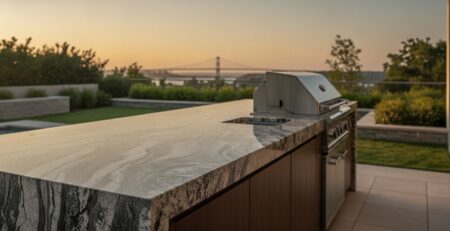
Natural granite is the premier choice for the demanding outdoor climates of New Jersey and the surrounding metro area. It remains stable under direct UV exposure and withstands the region’s intense freeze-thaw cycles without cracking. Quartz resins are sensitive to sunlight and will eventually yellow or degrade when used in an uncovered outdoor setting. Understanding the granite vs quartz countertops pros and cons for exterior use is vital for preserving your outdoor investment.