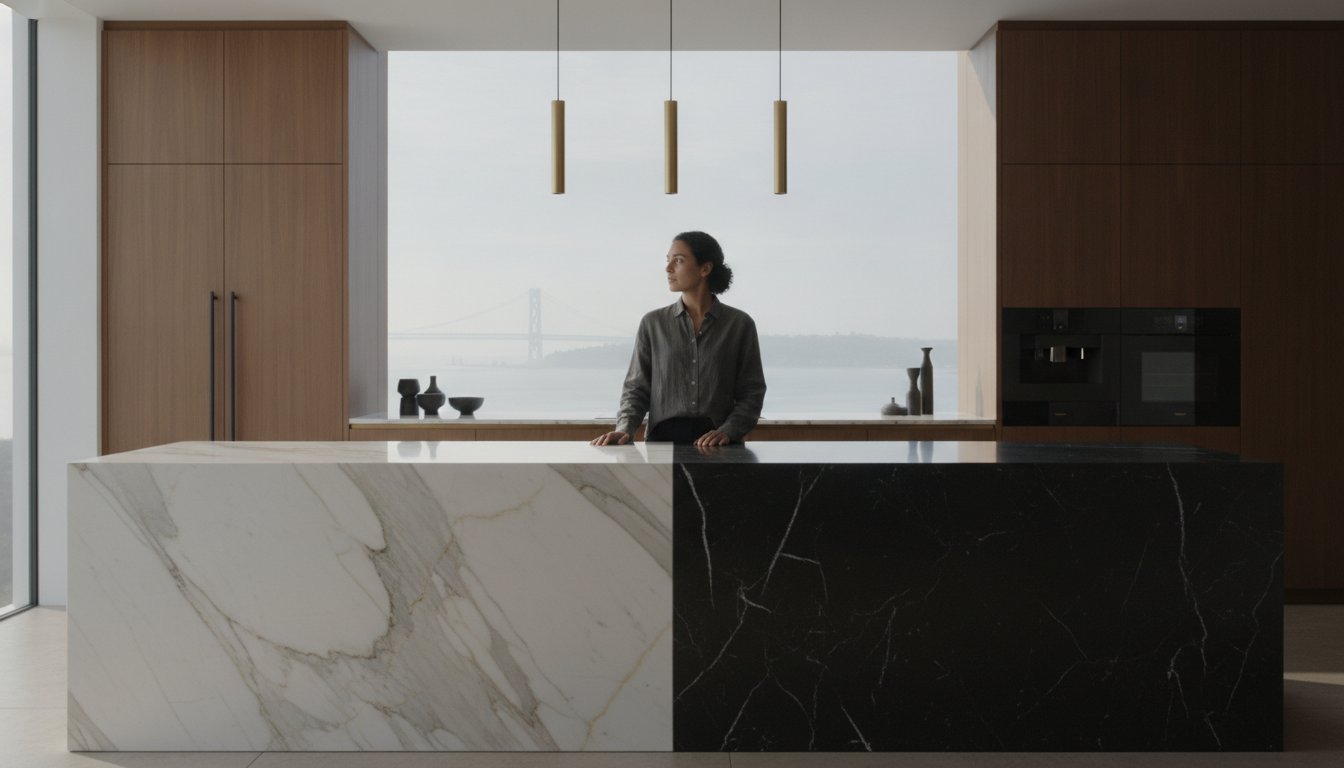

Marble vs. Quartzite: The Master Artisan’s Guide to Durability and Maintenance
The most expensive mistake in a luxury kitchen isn’t choosing the wrong stone; it’s misunderstanding the soul of the material you’ve invited into your home. Many homeowners feel a deep sense of trepidation regarding the permanent etching of marble or the confusion of mislabeled slabs. When evaluating marble vs quartzite durability and maintenance, you’re not just comparing mineral hardness. You’re selecting a legacy. You’re choosing between a stone that chronicles your family’s history and one that stands as a geological fortress.
It’s natural to desire a surface that reflects both your taste and your lifestyle’s demands. With the demand for quartzite growing at a rate of 12% annually, it’s clear that homeowners are increasingly prioritizing natural resilience. This guide offers a definitive comparison between marble’s evolving elegance and quartzite’s legendary strength to help you select the perfect element for your legacy home. We’ll examine the “patina versus damage” debate and provide a clear decision framework. You’ll gain the confidence to distinguish true quartzite from its softer counterparts and understand how modern finishes, like the increasingly popular honed or leathered textures, influence long-term care.
Key Takeaways
- Understand the elemental origins that dictate how marble’s calcite-rich composition and quartzite’s sandstone transformation influence their performance in high-traffic environments.
- Master the nuances of marble vs quartzite durability and maintenance to distinguish between the natural evolution of a living patina and preventable surface damage.
- Learn to navigate the etching phenomenon, discovering why quartzite resists acidic reactions while marble gracefully records the passage of time.
- Adopt the 2026 preservation protocols, including advanced polymer sealing and pH-neutral daily rituals, to protect your investment for generations.
- Utilize our artisan’s decision framework to match specific stone characteristics with your household’s culinary habits and aesthetic priorities.
Geological Identity: Why Marble and Quartzite Perform Differently
To select the ideal surface for a legacy home, one must first respect the deep time required to forge it. The Geological Identity of Marble begins as sedimentary limestone, undergoing a metamorphic, heat-driven baptism that recrystallizes it into a tapestry of calcite. Conversely, quartzite is the result of pure quartz sandstone being crushed and fused under tectonic pressure until the individual grains vanish into a singular, glass-hard mass. This distinction is the root of every performance difference you’ll encounter.
Understanding this fundamental divergence is essential when considering marble vs quartzite durability and maintenance. While they may share a similar ethereal aesthetic, their chemical souls dictate vastly different behaviors within a busy kitchen or bath. From an artisan’s perspective, the stone’s density isn’t just a technical specification; it defines the very limits of what can be achieved during the fabrication process. A master knows that the way a stone responds to a diamond blade reveals its internal history and future resilience.
The Calcite Factor in Marble
Marble’s grace comes from its calcite-rich composition. This calcium carbonate base is why the stone feels soft to the touch and remains naturally cool, making it the preferred choice for pastry chefs who value a surface that doesn’t melt delicate butter. However, this same chemistry makes it vulnerable to “etching” when it meets common household acids like lemon juice or vinegar. For the craftsman, this relative softness is a gift. It allows for the creation of intricate, hand-carved edge profiles and delicate ogee details that harder stones simply cannot sustain without risking structural fractures. It’s a material that invites the human hand to leave a mark, both through the artisan’s chisel and the homeowner’s daily life.
The Crystalline Strength of Quartzite
Quartzite represents geological defiance. Through intense heat and pressure, the sandstone’s porous nature is eliminated, creating a non-porous shield that sits high on the Mohs hardness scale. In many cases, it outranks both granite and glass in terms of sheer resistance. This crystalline strength ensures that quartzite resists scratching and heat with unmatched stoicism, making it ideal for high-traffic culinary environments where durability is paramount. For the fabricator, this hardness presents a significant challenge. Cutting genuine quartzite requires specialized, high-grade diamond-tipped tools and a much slower, more deliberate pace to prevent “chipping” the edges or “burning” the stone’s surface. It’s a material that demands respect and mastery from the initial cut to the final polish, as any error in the workshop is nearly impossible to correct later.
The Durability Duel: Scratching, Etching, and Heat Resistance
The choice between these two stones often reveals a homeowner’s philosophy toward perfection. While both are natural marvels, their reaction to a spilled glass of wine or a heavy cast iron skillet differs significantly. In the dialogue regarding marble vs quartzite durability and maintenance, we must look beyond the surface to the molecular resilience of the material. One stone invites the story of your life to be written upon it, while the other stands as a stoic witness to your daily rituals.
Thermal endurance is a hallmark of natural stone, offering a significant advantage over resin-based synthetic surfaces. You can place a hot pot on these surfaces without the immediate fear of scorching, though we always recommend a trivet to prevent thermal shock. Structural integrity becomes the primary focus in high-traffic NYC kitchens where the pace is relentless. The Artisan’s Verdict on material hardness confirms that while quartzite is harder, its rigidity makes edge profiles more prone to chipping if not handled with expert precision during the fabrication process.
Etching vs. Staining: Clearing the Confusion
Etching is a physical change in the stone’s surface texture caused by chemical erosion, rather than the absorption of pigment. This distinction is vital for any collector of fine stone. Modern sealants provide a formidable barrier against liquid penetration, effectively preventing deep-seated stains from coffee or oils. Yet, these sealants cannot neutralize the chemical reaction between acidic liquids and marble’s calcite composition. For the active cook who values a pristine appearance, quartzite’s immunity to these acidic reactions is a decisive factor. It offers the visual serenity of white stone without the constant vigilance required during a dinner party.
Heat and Impact: The Physical Limits
The rigors of large family gatherings, sometimes referred to as the “Staten Island Kitchen” test, demand a stone that survives heavy cookware and accidental strikes. While quartzite outranks most materials in scratch resistance, the vulnerability of any stone lies in its corners and edges. Proper fabrication mitigates this risk by utilizing slightly rounded profiles that disperse impact energy. If you are envisioning a space that balances this rugged utility with refined grace, exploring the curated selections at Richmond Stone will help align your vision with the right geological partner. Whether you choose the resilience of quartzite or the classic evolution of marble, the final result should be a surface that feels as permanent as the home it inhabits.
The Maintenance Mandate: Preservation Protocols for 2026
True luxury isn’t merely acquired; it’s curated through disciplined stewardship. As we look toward the 2026 landscape, the methodologies for protecting natural stone have evolved beyond simple topical treatments. We now utilize advanced polymer technology that bonds at a molecular level, offering a defense that traditional impregnators can’t match. Understanding the nuances of marble vs quartzite durability and maintenance requires a shift from reactive repairs to proactive preservation. This is particularly true in the Tri-State area, where the pace of home life demands surfaces that can withstand both grand entertaining and daily culinary rigor.
Richmond Stone’s approach to long-term stone preservation focuses on the intersection of modern chemistry and traditional craftsmanship. We view ourselves as the premier guardian of your home’s natural elements, ensuring that the stone we install today remains a masterpiece for generations. This commitment involves educating homeowners on the rhythmic flow of care, moving away from the frantic use of harsh chemicals toward a more measured, pH-neutral cleaning philosophy.
Sealing: Your Stone’s Invisible Shield
A stone’s first defense begins in the artisan’s workshop. We insist on professional-grade sealing during the fabrication phase, as this is when the material is most receptive to deep penetration. To verify the integrity of your surface at home, perform the “Water Drop Test.” Place a small bead of water on the stone; if it remains a tight sphere after ten minutes, your shield is intact. If the water darkens the stone or spreads, the seal has been compromised. The frequency of this ritual depends on your specific use-case and the material’s porosity, adhering to the Natural Stone Institute design and construction standards for long-term material stability. While quartzite is naturally less porous, it still requires this invisible barrier to prevent rare but stubborn deep-seated stains.
Daily Care and Emergency Response
Sophisticated care relies on a steady, gentle touch. Your “never” list should be absolute: avoid bleach, vinegar, and ammonia, as these common household agents will strip sealants and dull a polished finish instantly. For marble, which we’ve established is more sensitive to chemical reactions, immediate action is the only protocol. If an acidic spill occurs, blot the area with a clean cloth. Don’t wipe, as this can spread the acid across a larger surface area. For deep-set oil stains that have bypassed the sealer, “Poultice 101” involves creating a paste of baking soda and water to draw the contaminant out of the stone’s pores over 24 to 48 hours. We recommend a professional assessment every three to five years to evaluate the surface’s health, ensuring your investment transcends fleeting trends to offer lasting value.

Aesthetic Evolution: Patina vs. Static Perfection
Beauty is not a static concept. When selecting a natural surface, you’re choosing how your home will communicate with the future. The debate surrounding marble vs quartzite durability and maintenance often centers on physical resilience, yet the most profound distinction lies in the visual narrative each stone project’s over time. One material embraces the ephemeral nature of life, while the other offers a stoic, unchanging grace that looks as pristine in twenty years as it does the day of installation.
Your choice depends on whether you value a living finish or a permanent masterpiece. For the perfectionist, the sight of a faint ring from a chilled glass is a flaw to be corrected. For the romantic, that same mark is a memory of a summer evening, a subtle chronicle of a life well-lived. Understanding your psychological response to these changes is as vital as understanding the stone’s mineralogy.
The Romance of the Marble Patina
The great monuments and cafes of Europe inform a perspective where stone is a living element. In Italy and France, the softened edges and etched surfaces of ancient marble are seen as a badge of heritage rather than a lack of care. This “living finish” allows the stone to evolve alongside the home. To manage this transition, many homeowners now favor a honed finish. Unlike a high-gloss polish, a honed surface is matte and velvet-like, which naturally masks light etching and makes daily care far more forgiving. Ensuring that professional marble fabrication is handled by masters who understand grain orientation and edge softening is the secret to a stone that ages with aristocratic poise.
Quartzite: The Unchanging Masterpiece
Quartzite serves those who demand the “Day One” look for decades. It’s the ideal solution for the homeowner who desires the dramatic, sweeping veining of a Calacatta or Statuario marble but refuses to compromise on surface stability. Because quartzite is chemically inert to household acids, it maintains its original luster without the development of a patina. This stone mimics the most prestigious marbles in the world while offering a geological fortress that resists the passage of time. It provides a sense of certainty in high-traffic environments, ensuring your kitchen remains a sanctuary of static perfection. If you’re ready to explore these diverse aesthetic paths, our consultants at Richmond Stone can guide you through our curated slabs to find the exact match for your design philosophy.
The Artisan’s Verdict: Choosing the Right Stone for Your Project
The final synthesis of your design journey requires a departure from abstract comparisons toward a concrete alignment with your daily life. In the final assessment of marble vs quartzite durability and maintenance, the decision rests upon the rhythm of your household. We don’t view these materials as mere products, but as foundational elements that must support your unique legacy. Whether you seek the historical resonance of marble or the geological defiance of quartzite, your selection should be an uncompromising reflection of your values and your home’s architectural soul.
In the competitive New York and New Jersey real estate markets, the permanence of high-tier natural stone serves as a significant anchor for property value. A masterfully executed installation does more than provide a surface; it signals a commitment to quality that transcends fleeting trends. Richmond Stone remains a premier guardian of this process, overseeing every stage from the initial sourcing of rare slabs to the meticulous, hand-finished installation that ensures your investment endures for generations.
The Lifestyle Assessment
Before committing to a specific slab, consider the environmental demands of your specific borough or neighborhood. A high-use townhouse kitchen in Brooklyn, where culinary experimentation is a daily ritual, often demands the stoic resilience of quartzite. Conversely, a Staten Island master bath or a formal fireplace surround may be the perfect sanctuary for the evolving elegance of marble. Ask yourself if you are prepared to embrace the “living finish” of a stone that records the passage of time, or if you require a surface that remains frozen in its day-one perfection. Balancing your aesthetic desires with your functional requirements is essential, especially when sourcing high-quality quartzite countertops to ensure maximum durability in high-traffic zones.
Final Selection and Next Steps
The mastery of stone selection cannot be achieved through small samples alone. We insist that our clients view full slabs to appreciate the grand scale of the veining and the subtle shifts in mineral composition. This is also the stage where we verify the stone’s true identity. The market is often clouded by “soft quartzite,” which is frequently a dolomitic marble mislabeled to appeal to durability concerns. As artisans, we perform rigorous checks to ensure you are investing in genuine, crystalline quartzite when that is the performance level you require. To experience these materials first-hand and find the perfect partner for your project, Schedule a consultation to walk through the curated selections at our Richmond Valley Road showroom. Let us help you select the stone that will define your home’s enduring heritage.
Selecting the Foundation of Your Legacy
Choosing a surface is an act of curation that defines the character of your most intimate spaces. We’ve explored how marble’s metamorphic elegance contrasts with quartzite’s crystalline fortress, revealing that the right choice depends on your personal philosophy of beauty. Whether you embrace the historic patina of a living finish or demand the static perfection of a geological shield, the result should be a masterpiece of both nature and craft.
Navigating the complexities of marble vs quartzite durability and maintenance requires a partner who respects the raw elements as much as the finished architectural feature. With over 30 years of family-owned artisan expertise, we operate a master fabrication facility in Staten Island dedicated to serving all NYC boroughs and the NJ Metro area. We invite you to Experience the Timeless Legacy of Natural Stone; Visit the Richmond Stone Showroom. Your legacy home deserves a surface that stands as a testament to uncompromising quality and the enduring artistry of the natural world.
Frequently Asked Questions
Is quartzite really harder than granite for daily kitchen use?
True quartzite is indeed harder than most granites. On the Mohs scale of mineral hardness, quartzite typically ranks at a 7 or higher, while granite generally sits between 6 and 7. This geological density makes quartzite exceptionally resistant to scratches from stainless steel knives and heavy cookware. It’s a formidable material that thrives in high-traffic environments where durability is the primary requirement.
Can I use lemon juice or vinegar to clean my marble countertops?
You should never use acidic substances like lemon juice or vinegar on marble surfaces. These liquids react instantly with the stone’s calcium carbonate composition, causing permanent surface etching. This chemical erosion dulls the finish and leaves cloudy marks that can’t be wiped away. Always utilize pH-neutral cleaners designed for natural stone to maintain the integrity and luster of your investment.
What is ‘soft quartzite’ and why should I be wary of it?
‘Soft quartzite’ is a misleading industry term often used for dolomitic marble. It’s vital to be wary because these slabs contain calcite or dolomite, meaning they will etch when exposed to acids, unlike true quartzite. A master artisan can verify a slab’s identity through a glass scratch test. Investing in mislabeled stone can lead to unexpected maintenance challenges and surface damage in an active kitchen.
Does sealing my marble countertop prevent it from etching?
Sealing does not prevent etching. While high-grade sealants are an essential part of marble vs quartzite durability and maintenance to block liquid absorption and staining, they don’t stop chemical reactions. Etching is a physical change in the stone’s surface texture that occurs when acids meet the stone’s mineral soul. Protection against etching requires either a honed finish to mask marks or constant vigilance with acidic materials.
How often do I need to professionally reseal my quartzite?
We recommend a professional resealing every three to five years for quartzite surfaces. Although quartzite is naturally less porous than many other stones, a consistent maintenance schedule ensures its invisible shield remains impenetrable. Perform the water drop test annually to monitor the seal’s performance. If water no longer beads on the surface but begins to soak in, it’s time to call a professional for a refresh.
Can marble countertops be restored if they become heavily etched or stained?
Marble is a remarkably forgiving material that can be professionally restored to its original glory. A master fabricator can utilize diamond abrasives to gently remove the top layer of damaged stone, effectively erasing etches and shallow scratches. This process allows you to reset the stone’s appearance, whether you prefer a high-gloss polish or a velvet-like honed finish. It’s a testament to the stone’s lasting value and heritage.
Which stone is better for an outdoor kitchen in the New Jersey climate?
Quartzite is the superior choice for outdoor kitchens in the New Jersey and New York Metro area. Its dense structure handles the intense freeze-thaw cycles of our local climate with far more resilience than softer stones. Quartzite also resists UV degradation, ensuring that its vibrant colors and intricate veining don’t fade under the summer sun. It’s a stone that stands as a stoic guardian against the elements.
Is the price difference between marble and quartzite significant in 2026?
The price difference in 2026 is largely dictated by the rarity of the specific slab and the complexity of its fabrication. While common marble varieties like Carrara remain accessible, exotic quartzites often command a premium due to the specialized diamond tools required to cut such hard material. Both stones represent a significant investment in a legacy home, with their long-term ROI tied to the quality of the artisan’s installation and care.