

Granite vs Marble Countertops: A Master Artisan’s Guide to the Eternal Choice (2026)
The decision to crown your kitchen with natural stone is a definitive moment in the creation of a home’s legacy. Choosing between granite vs marble countertops is less a matter of simple aesthetics and more a profound commitment to how you intend to exist within your most intimate spaces. You likely appreciate the silent authority of a masterfully crafted surface, yet you may fear the vulnerability of a soft patina or the risk of a material that feels trapped in a passing trend. It’s a delicate balance to strike between the ethereal beauty of a mountain’s heart and the ironclad resilience required for daily life.
We understand that selecting a surface is an investment in permanence. You deserve a sanctuary that balances the raw artistry of the natural world with the practical demands of a modern, sophisticated lifestyle. This guide provides a definitive understanding of stone performance, moving beyond surface level comparisons to help you select a material with quiet confidence. We’ll examine the intricate differences in durability, the reality of long term care in 2026, and how these elemental choices influence your home’s ultimate architectural value.
Key Takeaways
- Decipher the geological narrative of your stone to choose between the volcanic strength of granite and the metamorphic grace of marble.
- Master the maintenance requirements of granite vs marble countertops, ensuring you understand how to protect marble’s delicate patina or leverage granite’s enduring stability.
- Evaluate the visual impact of each material, comparing the ethereal glow of marble’s translucence against the rich, crystalline depth of granite.
- Discover why the custom fabrication process is the true bridge between a raw slab and a finished masterpiece that increases your home’s heritage value.
- Learn to select a surface that doesn’t just satisfy a trend but serves as a permanent architectural anchor for your home’s future.
The Eternal Choice: Granite vs Marble in Modern Architectural Design
Natural stone has always served as a silent witness to human history, a marker of prestige that transcends fleeting generations. In the grand estates of Europe and the historic brownstones of New York City, stone represents a commitment to permanence. The debate regarding granite vs marble countertops is not merely a technical comparison. It’s a philosophical exploration of how you wish to inhabit your space. One material offers the unyielding strength of a mountain’s core, while the other provides a soft, metamorphic elegance that matures alongside your family.
As we move through 2026, the design world is witnessing a decisive pivot away from the clinical perfection of synthetic surfaces. Discerning homeowners are rediscovering the allure of raw, honest materials that tell a story. Granite stands as a geological fortress, offering unyielding stability and crystalline depth. Marble, conversely, acts as a living canvas, a metamorphic masterpiece that records the passage of time through its evolving patina. This return to authenticity reflects a desire for homes that feel grounded and connected to the natural world.
The Resurgence of Natural Elements in NYC Homes
From the high rises of Manhattan to the expansive kitchens of Staten Island, designers are increasingly layering natural textures to create depth and warmth. A countertop is more than a utility; it’s the visual anchor that dictates the kitchen’s atmospheric weight. Moving away from mass-produced looks, many are turning to custom countertops in Staten Island to ensure their stone is hand-selected and precisely fabricated to match their home’s unique architectural soul. This bespoke approach ensures that every vein and crystal is positioned to highlight the room’s natural light and flow.
Defining Your Lifestyle Requirements
Your choice depends on how you engage with the heart of your home. Is your kitchen a high-traffic laboratory for culinary experimentation or a social gallery for quiet reflection? The “perfect” stone is the one that aligns with your aesthetic vision and your willingness to embrace natural evolution. Consider these lifestyle factors before making your selection:
- Tolerance for Evolution: Are you inspired by the “living finish” of marble, where subtle etching becomes a map of shared meals, or do you prefer the eternal consistency of granite?
- Culinary Habits: A kitchen used for frequent, high-heat cooking may benefit from granite’s volcanic resilience, while a space focused on baking often thrives on marble’s naturally cool surface.
- Maintenance Philosophy: Your decision between granite vs marble countertops should reflect your willingness to engage in routine care, such as periodic sealing and mindful cleaning.
Ultimately, the selection process is an intimate consultation between your vision and the raw material. By understanding the inherent character of these stones, you can choose a surface that doesn’t just fill a space, but defines a legacy.
Geological Integrity: Understanding Composition and Hardness
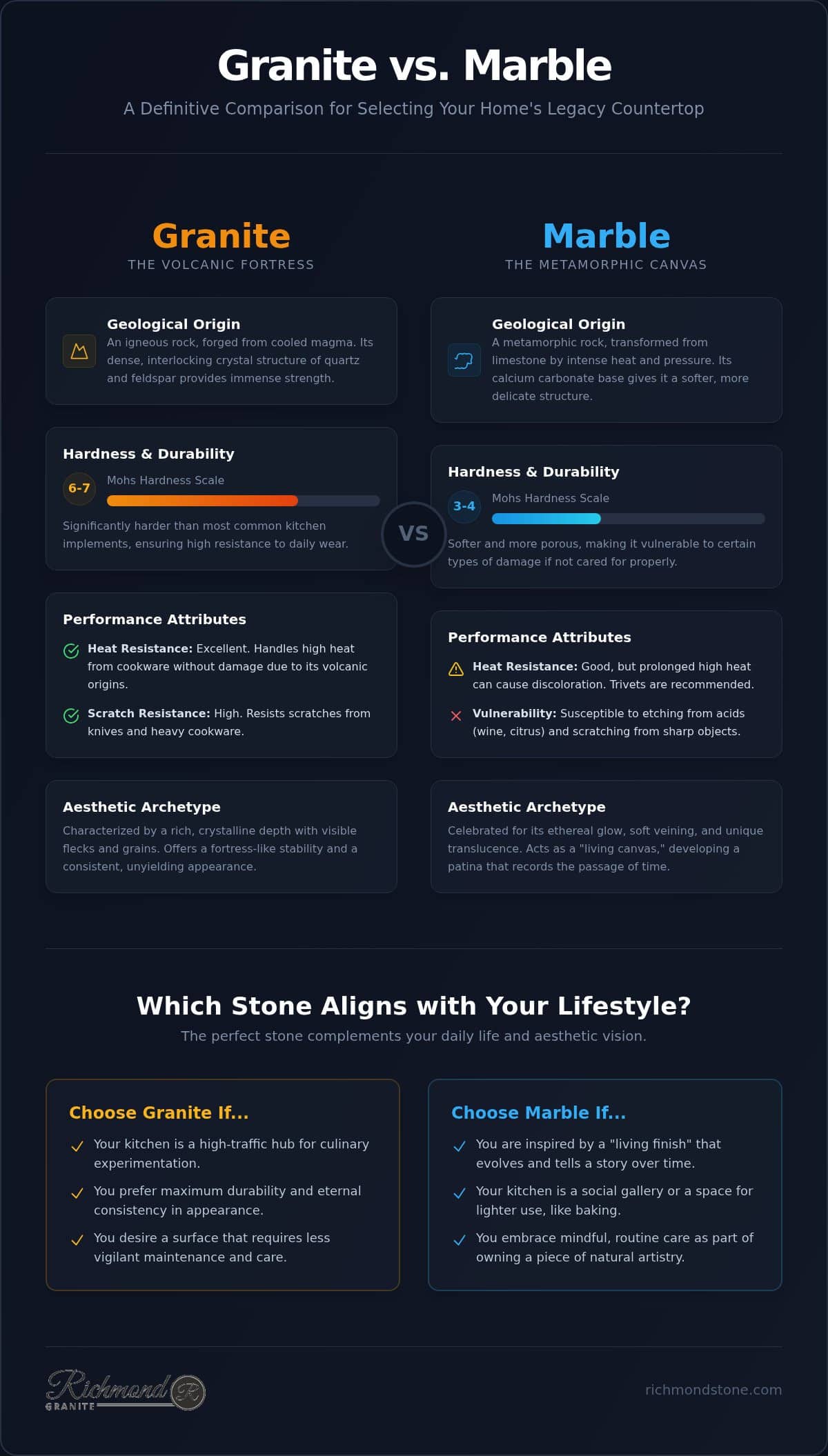
The distinction between these two elements begins miles beneath the earth’s crust. When we compare granite vs marble countertops, we are comparing two entirely different geological histories. Granite is an igneous rock, a product of volcanic fire and slow, pressurized cooling. This results in a dense, interlocking structure of quartz and feldspar. Marble is metamorphic, a stone that has undergone a profound transformation from humble limestone into a recrystallized work of art. This difference in origin dictates everything from how the stone reflects light to how it responds to a spilled glass of wine.
The Molecular Strength of Granite
Granite is often defined by its silica content, which provides its signature hardness. On the Mohs scale, granite typically registers between a 6 and 7, making it significantly harder than common kitchen implements. This volcanic heritage ensures it can handle high heat and resist scratches from stainless steel knives or heavy cookware. It’s the ideal choice for high-traffic areas or outdoor kitchens where durability is paramount. You can identify this strength by the stone’s crystalline appearance, characterized by intricate flecks and a visual depth that suggests a fortress-like stability.
The Delicate Artistry of Marble
The elegance of marble is rooted in its calcium carbonate base, a mineral that allows light to penetrate the surface before reflecting back. This creates the “glow” that has captivated architects for millennia. However, this same chemistry makes marble susceptible to acids. On the Mohs scale, marble sits between a 3 and 5, meaning it is softer and more prone to the physical marks of a busy kitchen. Not all natural stone is created equal, though. Vermont Danby marble, for example, is notably denser than Italian Carrara, offering a higher level of resistance to moisture and staining. Choosing the right variety requires a master’s eye for detail. If you wish to witness these geological nuances firsthand, consult with our stone specialists to find your perfect match. Finding the right balance in the granite vs marble countertops debate requires understanding these deep geological roots.
Endurance and Maintenance: Navigating Daily Realities
Daily life is the true test of architectural stone. The choice between granite vs marble countertops often hinges on how one manages the inevitable interaction of culinary acids and thermal shock. While granite offers a shield, marble offers a story. It is vital to distinguish between etching and staining. Etching is a chemical dulling of the stone’s surface, typically caused by acidic substances like lemon juice or vinegar reacting with marble’s calcium carbonate. Staining, conversely, is a matter of porosity, where liquids penetrate the stone’s microscopic canals.
Thermal resistance is another defining factor in the endurance of these materials. Granite handles a hot pot with volcanic indifference, a direct result of its igneous formation. Marble, while naturally cool to the touch, requires more caution. It can suffer from thermal shock or subtle discoloration if extreme heat is applied directly to the surface without a trivet. When evaluating granite vs marble countertops for a busy household, your culinary habits dictate which level of protection you require.
Professional-grade sealants in 2026 have significantly narrowed the maintenance gap that once separated these stones. Master fabricators now utilize high-performance, oleophobic treatments that bond at a molecular level. These modern solutions move beyond the superficial wax coatings of the past, providing deep-seated protection that lasts for years rather than months. This technological advancement allows homeowners to select stone based on aesthetic desire rather than purely out of fear of maintenance.
Granite: The Low-Maintenance Standard
Granite remains the undisputed king of the high-traffic family kitchen. Its dense structure makes it nearly impervious to the scratches and etches that might plague softer materials. To maintain the prestige of granite countertops, you only need a pH-neutral cleaner and a soft cloth. While it’s incredibly durable, it isn’t indestructible. You should avoid heavy impacts on the edges, as the crystalline structure can chip if struck with significant force by a cast-iron pan or heavy vessel.
Marble: Embracing the Patina
In many European cultures, the aging of marble is considered a mark of a well-lived home rather than a defect. This “living finish” develops a patina that tells the story of every meal shared. If you prefer a more pristine look, we often recommend a honed finish. A honed, matte surface hides etches and light scratches much more effectively than a high-gloss polished finish. Using specialized stone cleaners designed to support the stone’s alkaline nature will preserve its structural integrity and luminous glow for decades.
The Aesthetic Archetypes: Matching Material to Vision
Selecting the right stone is an exercise in visual storytelling. The choice between granite vs marble countertops often centers on the tension between crystalline structure and fluid veining. Granite presents a visual language of granular depth, where individual minerals create a rhythmic, speckled pattern that feels grounded and permanent. Marble, by contrast, offers a more ethereal experience. Its unique translucency allows light to penetrate the surface before reflecting back, creating a characteristic “glow” that has made it the hallmark of luxury for centuries.
Color palettes range from the profound, light-absorbing depth of Absolute Black granite to the sweeping, dramatic veining of Calacatta marble. When weighing the aesthetic merits of granite vs marble countertops, consider the atmospheric weight you wish to achieve. Achieving a harmonious environment requires these elements to integrate seamlessly with your custom kitchen cabinets, ensuring the stone’s movement complements the cabinetry’s grain and finish. This interplay of textures defines the room’s architectural legacy.
Design Applications for Granite
Granite is the premier choice for expansive surfaces that require visual stability, such as large kitchen islands or perimeter counters. It excels in high-use areas like wet bars where its dense pattern hides minor debris and water spots. In 2026, we are seeing a significant rise in leathered and honed finishes. These tactile options provide a matte, organic feel that emphasizes the stone’s natural mineral composition without the high-gloss reflection of traditional polishing. Pairing these muted textures with minimalist cabinetry creates a sophisticated, contemporary aesthetic that feels both modern and timeless.
Design Applications for Marble
Marble remains the gold standard for spaces designed for quiet elegance and focused craft. It is the preferred surface for pastry stations due to its natural thermal mass, which keeps dough cool during preparation. In master vanities and formal bathrooms, marble’s luminosity creates a sanctuary-like atmosphere that synthetic materials cannot replicate. For a truly bespoke statement, book-matched slabs can be used on backsplashes or feature walls to create symmetrical, mirror-image patterns that serve as natural fine art. If you are ready to select the stone that will define your home, view our exclusive inventory of premium slabs.
The Artisan’s Consultation: Choosing Your Legacy Surface
The journey from a raw slab to a finished masterpiece is a transformation guided by the hand of a master artisan. While the visual allure of a slab often captures the heart, the technical execution of the fabrication determines its longevity. In the debate of granite vs marble countertops, the quality of the cut is as vital as the stone’s origin. A master fabricator possesses the seasoned intuition to identify internal fissures or structural dry veins that remain invisible to the untrained eye. At Richmond Stone, we treat every project as a curated work of art, ensuring that the stone’s intrinsic weaknesses are mitigated before the first diamond blade touches the surface.
Our process is rooted in a 30-year family-owned legacy of precision. We understand that a countertop isn’t a mere utility; it’s a permanent architectural feature. This commitment to quality means we don’t just supply stone; we act as guardians of the material. By carefully analyzing the mineral composition and density of every slab, we ensure the final installation resists the pressures of daily life while maintaining its prestigious aesthetic. This level of scrutiny is what separates a standard renovation from a home’s defining legacy.
The Importance of Custom Templating
The architectural diversity of New York City, from historic Staten Island estates to modern Manhattan penthouses, demands absolute precision. We utilize advanced digital templating to account for the subtle irregularities of every wall and cabinet. This ensures a seamless fit that mass-produced solutions simply cannot replicate. Beyond the fit, the character of the stone is further defined by its edge profile. A classic Ogee edge evokes a sense of traditional heritage, while a bold Mitered edge provides a clean, monolithic look that emphasizes the slab’s thickness. Our artisans prioritize vein continuity across every seam, ensuring the visual flow remains uninterrupted, creating a cohesive masterpiece.
Making the Final Selection
Ultimately, the choice between granite vs marble countertops is a reconciliation of the head and the heart. Granite offers the peace of mind of unyielding stability, while marble provides an emotional connection to the raw artistry of the earth. We encourage a “Touch Test” at our facility; there is no substitute for physically feeling the cool, crystalline energy of the stone. This sensory experience often provides the clarity needed to decide which material will define your home’s legacy. We invite you to visit the Richmond Stone showroom in Staten Island to find your perfect match and witness the intersection of nature and craftsmanship.
Defining Your Home’s Architectural Legacy
Selecting the ideal surface is an intimate reconciliation of your aesthetic desires and your daily realities. You’ve explored the geological fire that grants granite its unyielding resilience and the metamorphic grace that allows marble to glow with a unique luminosity. The choice between granite vs marble countertops is ultimately a decision that shapes the soul of your most personal spaces. Whether you prioritize the eternal stability of an igneous fortress or the evolving history of a living patina, the true value of your investment rests in the precision of the artisan’s hand.
Richmond Stone brings over 30 years of family-owned mastery to every project we undertake. We proudly serve all NYC boroughs and the NJ Metro area, managing every detail of expert fabrication and installation entirely in-house. This comprehensive oversight ensures that your stone is handled with the reverence it deserves. Begin your custom stone journey with Richmond Stone and transform your vision into a permanent work of art. Your home deserves a surface that reflects its heritage and your uncompromising standard of excellence.
Frequently Asked Questions
Is marble or granite better for resale value in the NYC market?
Marble often commands a higher prestige in the luxury NYC market, signaling an uncompromising commitment to classic elegance. While granite is respected for its unyielding durability, marble is frequently the preferred choice for high-end residential listings in Manhattan and Brooklyn. It suggests a level of bespoke refinement that buyers in the premier market segment expect when viewing a property’s architectural details.
Can I use marble in a kitchen if I cook with a lot of acidic ingredients?
You can certainly use marble in a culinary space focused on acidic ingredients, provided you select a honed finish. Polished surfaces show etches from lemon juice or vinegar almost instantly. A honed surface allows these marks to blend into the stone’s evolving patina. It’s a choice for those who value the living nature of natural materials over surgical perfection.
Does granite really need to be sealed every year?
Granite doesn’t always require annual sealing. The frequency depends entirely on the stone’s density and the quality of the treatment applied during fabrication. Modern, high-performance sealants available in 2026 can protect the surface for several years. We recommend a simple water-bead test to determine if the protective barrier remains intact or needs professional replenishment by a master artisan.
What is the main difference between ‘etching’ and ‘staining’ on marble?
The distinction between etching and staining is fundamental to understanding granite vs marble countertops. Etching is a physical change to the stone’s surface, a dull spot caused by a chemical reaction between acids and calcium carbonate. Staining occurs when a dark liquid, like red wine or oil, penetrates the stone’s pores. One is a surface blemish; the other is a deep-seated discoloration.
Are there granites that look like marble for a lower-maintenance option?
Several varieties of granite offer the ethereal aesthetic of marble with the volcanic strength of igneous rock. Stones like Bianco Romano or certain white granite selections provide soft grey veining against a pale background. These options allow you to achieve a classic aesthetic while benefiting from a material that is significantly more resistant to the rigors of a high-traffic family kitchen.
How do I remove a stain from a natural stone countertop?
Removing a stain from natural stone requires a poultice, a paste designed to draw the liquid out of the stone’s pores. You mix a specific cleaning agent with an absorbent material, apply it to the area, and allow it to dry over 24 to 48 hours. This process gently pulls the contaminant back to the surface. It is a patient, precise method that respects the material’s integrity.
Can I place hot pans directly on a granite countertop?
Granite is exceptionally heat resistant and can generally withstand hot pans placed directly on its surface. Its volcanic origin allows it to endure temperatures that would scorch or crack synthetic alternatives. We still suggest using trivets for extremely high-heat vessels to avoid any risk of thermal shock or trapped moisture, preserving the stone’s crystalline finish and structural stability for decades.
What are the most durable marble varieties for kitchen use in 2026?
Vermont Danby remains the premier choice for durability among marble varieties in 2026. It possesses a lower absorption rate than many Italian marbles, making it more resistant to moisture and staining. When comparing granite vs marble countertops, selecting a dense variety like Danby allows you to enjoy the prestige of marble with a performance profile that more closely rivals its igneous counterparts.