
Stone Fireplace Surrounds in NYC: A Master Artisan’s Guide to Architectural Elegance (2026)
A fireplace in a Manhattan penthouse or a Brooklyn brownstone is far more than a functional heat source. It’s the architectural heartbeat of the home. When you invest in stone fireplace surrounds NYC, you aren’t just buying material. You’re commissioning a permanent legacy that must withstand both the intense heat of the hearth and the unique logistical complexities of the city itself. It’s a choice that defines the character of your space for generations.
We understand that the path to a perfect hearth often feels fraught with technical hurdles. You might worry about the logistics of moving a massive, delicate marble slab into a high-rise, or fear that your chosen stone won’t endure the thermal stress of a modern burner. These concerns are valid, yet they shouldn’t deter you from achieving a singular design. We promise to guide you through the transition from raw earth to a refined architectural feature. In this guide, we’ll explore the selection of heat-resistant materials like soapstone and marble, the meticulous artistry of book-matched fabrication, and the white-glove installation techniques required for the Tri-State area’s most demanding properties.
Key Takeaways
- Learn to identify the core components of a custom surround, from the mantel to the hearth, that transform a simple firebox into a cohesive architectural statement.
- Compare the sophisticated elegance of marble with the superior thermal mass of soapstone to select a material that harmonizes with your home’s heating requirements and design language.
- Explore the precision of the master artisan’s process, where digital templating ensures that stone fireplace surrounds NYC integrate flawlessly into the character-filled, irregular spaces of the city.
- Prepare for the complexities of urban logistics by understanding the white-glove installation methods used to safely transport and set heavy natural stone within luxury residences.
- Discover the essential maintenance practices and the enduring value of a natural patina, ensuring your stone hearth remains a cherished legacy for decades to come.
The Anatomy of a Masterpiece: Defining the Stone Fireplace Surround
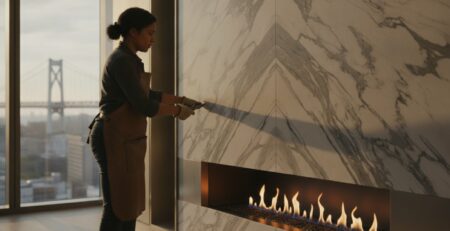
To understand The Anatomy of a Masterpiece, one must view the surround as the essential architectural bridge. It connects the raw energy of the fire with the refined interior of the home. For those seeking stone fireplace surrounds NYC, this isn’t merely a decorative border; it’s a structural statement of permanence. A custom surround consists of four primary elements: the mantel or shelf, the hearth that sits at the base, the vertical legs or jambs, and the header that spans the space above the firebox. Each component must be proportioned with surgical precision to balance the room’s scale.
Unlike mass-produced kits that rely on standardized molds and composite materials, a custom-fabricated stone slab is born from a single block of earth. This allows for a seamless flow of pattern that a cast product cannot achieve. In the high-end market of 2026, the shift away from engineered surfaces toward raw, unrefined elegance is undeniable. A bespoke surround feels heavy and grounded. It offers a sense of stability that defines a luxury residence.
To better understand how these components come together in a traditional setting, watch this helpful video:
The Aesthetic Impact of Natural Stone
Natural veining acts as a signature from the earth. Every swirl of color in a marble slab is unique, creating a focal point that cast stone replicates with a predictable, artificial rhythm. The choice between a mirror-like polished finish and a soft, tactile honed surface changes the entire mood of the room. This level of material coordination is particularly effective in open-concept layouts. You might pair your hearth stone with custom kitchen cabinets to create a unified architectural language across the living and dining spaces. It’s about creating a conversation between surfaces.
Historical Context in NYC Architecture
New York’s residential history is etched into its hearths. In the 19th-century Victorian brownstones of the Upper West Side, intricate carvings and multi-piece assemblies were the standard. Today, in the expansive lofts of Tribeca and Soho, the trend has shifted toward monolithic, single-slab designs that emphasize the scale and weight of the material. Using natural stone is a commitment to maintaining the heritage of these residences. It ensures that the fireplace doesn’t look like a modern afterthought. Instead, it feels like a feature that has always belonged to the building’s soul. This permanence is why natural stone remains the premier choice for the city’s most prestigious addresses.
Selecting the Material: Marble, Soapstone, and the Science of Heat
Choosing the right slab for a hearth is a dialogue between the designer’s eye and the engineer’s logic. In the context of stone fireplace surrounds NYC, the material must do more than look beautiful; it must endure the constant cycle of thermal expansion and contraction. Unlike wood or composite materials, natural stone possesses the density to absorb and radiate heat without compromising its structural integrity. It is a geological legacy brought into the domestic sphere.
Proper selection begins with understanding material properties. According to the Natural Stone Institute’s Dimension Stone Design Manual, the rate of thermal expansion varies significantly between marble, granite, and soapstone. High porosity can lead to soot penetration, while low density may result in heat-induced stress fractures over decades of use. A master artisan understands these nuances, selecting slabs that balance visual drama with the physics of the flame.
The Resilience of Soapstone
Soapstone remains the artisan’s secret for high-heat environments. Its remarkable thermal mass allows it to store heat and radiate it slowly back into the room long after the embers have died. It’s chemically inert and non-porous, meaning it won’t crack under extreme temperature shifts. Unlike marble, which requires careful sealing, soapstone is often treated with mineral oil to enhance its “living finish.” This process encourages a deep, soulful patina that darkens with age, reflecting the history of the home. It is perhaps the most honest material one can place near a fire.
Marble and Quartzite for Modern Luxury
For those seeking a more dramatic visual impact, marble and quartzite offer unparalleled movement. We often recommend book-matching, a technique where two mirroring slabs are joined to create a symmetrical, Rorschach-like masterpiece across the header and legs of the surround. While marble is the traditional choice for NYC elegance, quartzite provides a harder, more resilient alternative for families who use their hearth daily. Choosing natural stone is a commitment to a sustainable, “forever” material that transcends fleeting design trends. If you’re ready to see these materials in person, you can browse our curated slabs at Richmond Stone to find the perfect match for your interior.
Granite and limestone also remain stalwarts in the luxury market. Granite’s crystalline structure provides a depth of field that engineered surfaces simply cannot replicate. Whether you choose the quiet grace of a honed limestone or the bold, sweeping veins of a Calacatta marble, the goal is a surface that feels as substantial as the city it inhabits. Every material has a story, and the right choice ensures that story remains vibrant for generations.
The Fabrication Journey: Precision Templating and Hand-Refining
The transition from a raw geological specimen to a refined architectural feature is a path paved with technical precision. For those investing in stone fireplace surrounds NYC, the fabrication phase is where the vision is finally crystallized. It’s a journey that begins at our Staten Island facility, where over 30 years of family-operated expertise is applied to every high-value natural slab. Selecting the stone is only the first step; the true artistry lies in how that stone is shaped to fit the specific soul of your home.
Expert Templating for NYC Homes
New York City’s architectural landscape is notoriously irregular. Pre-war brownstones and historic chimneys rarely feature perfectly plumb walls or level floors. Traditional molded kits often fail here because they lack the adaptability required for these unique spaces. We utilize advanced digital templating to capture every nuance of your room’s geometry. This precision ensures that the surround fits flawlessly while strictly adhering to local fireplace and chimney safety standards. Our master fabricators don’t just measure; they advise on structural support and heat clearance, ensuring the installation is as secure as it is beautiful.
A critical component of this process is the art of the mitered edge. By precisely cutting and joining the stone at 45-degree angles, we create the illusion of massive, solid stone blocks without the prohibitive weight of a single monolithic piece. This technique requires an intimate understanding of the material’s grain. We meticulously align the natural veining so it flows uninterrupted across the mantel, legs, and header, preserving the stone’s visual story as it wraps around the hearth.
The Richmond Stone Difference
While technology provides the blueprint, the human hand provides the soul. Every edge we produce is hand-refined to ensure a soft, artisanal feel that machines alone cannot replicate. This commitment to manual finishing is what defines our approach to master stone fabrication. It’s a slow, deliberate process that respects the material’s history while embracing modern innovation. Whether we’re working with a delicate Thassos marble or a rugged soapstone, the goal remains the same: to produce a bespoke masterpiece that feels like a permanent part of the building’s legacy.

White-Glove Installation: Navigating the NYC and NJ Landscape
The physical weight of a natural stone slab is matched only by its fragility during transport. For homeowners seeking stone fireplace surrounds NYC, the installation phase represents the critical bridge between fabrication and the final architectural reality. This isn’t a task for general laborers. It requires a specialized team that understands the structural nuances of both the material and the diverse building types found across Manhattan, Brooklyn, and the NJ Metro area. Every movement must be calculated to preserve the integrity of the hand-refined edges we’ve spent weeks perfecting.
Our Staten Island facility serves as the strategic hub for these operations. Being local allows us to manage the intricate logistics of the Tri-State area with a level of precision that out-of-state suppliers simply cannot match. We coordinate directly with your interior designers and general contractors to ensure that the site is prepared, the structural supports are verified, and the delivery window is strictly respected. This collaboration is essential for a seamless transition from the workshop to the hearth.
Logistics in the Five Boroughs
Navigating the narrow stairwells of a historic West Village brownstone or the service elevators of a Park Avenue high-rise requires more than just muscle. Our white-glove approach begins with a comprehensive protection plan for your home. We use specialized equipment to transport heavy stone while safeguarding your floors, walls, and existing millwork. It’s a quiet, methodical process designed to minimize disruption. We treat your residence with the same reverence we show the raw materials in our care.
The timeline from the final digital template to the completed installation typically spans several weeks, depending on the complexity of the mitered edges and the sourcing of the slab. We believe that true luxury shouldn’t be rushed. Every join is checked for alignment, and every seam is treated with color-matched adhesives to ensure the final assembly looks like a single, monolithic piece of earth. If you’re ready to begin your project, you can schedule a consultation with Richmond Stone to discuss the logistical requirements of your specific property.
The Final Reveal
Once the stone is on-site, the master installer performs the final fitting. This involves ensuring the hearth is perfectly level and the mantel is securely anchored to the substrate. We perform a final hand-buffing to remove any fingerprints or dust, revealing the stone’s true depth and luster. It’s the moment when the raw slab finally becomes a permanent part of your home’s legacy.
Before we consider the job complete, we educate the homeowner on the “curing” process. For new stone surrounds, the first few fires should be small and controlled. This allows the stone and the setting materials to acclimate to the heat cycles gradually. It’s a final ritual that marks the beginning of the hearth’s life in your home. This careful introduction ensures that the stone remains stable and beautiful for decades to come.
Stewardship of the Hearth: Maintenance and Long-Term Value
The completion of an installation is merely the beginning of a multi-generational journey. Stewardship of stone fireplace surrounds NYC requires a shift in perspective from simple ownership to active guardianship. Natural stone isn’t a static product; it’s a living element that responds to the environment of your home. By adopting a few simple rituals, you ensure that the stone remains as commanding and elegant as the day it was first set into place.
Daily care doesn’t require the aggressive chemicals often suggested by mass-market retailers. In fact, heavy cleaners can strip the stone of its natural luster and damage the hand-refined finish. We recommend using only pH-neutral cleaners and soft, lint-free cloths to remove surface dust. For the hearth specifically, removing ash promptly prevents the build-up of acidic residues that can etch more sensitive stones like marble or limestone over long periods of time.
This evolution of the stone is part of its inherent charm. As the years pass, your fireplace will develop a subtle patina, a record of the fires burned and the lives lived around it. While some homeowners prefer a pristine, showroom-new look, many collectors of fine stone value these minor signs of wear as a mark of historical character. It’s the difference between a mass-produced object and a bespoke architectural feature that has truly become part of the building’s soul.
Should the stone eventually require a more comprehensive refresh, the advantage of natural slabs becomes clear. Unlike cast stone or thin veneers, solid natural stone can be professionally refinished and restored after decades of use. A master artisan can gently hone the surface to remove deep-set stains or minor scratches, returning the surround to its original glory. This capacity for renewal is why stone remains a premier investment for the city’s most prestigious residences.
Maintenance for Different Materials
The specific rituals of care depend entirely on the geological makeup of your surround. Soapstone enthusiasts often embrace the tradition of regular oiling with food-grade mineral oil, which deepens the stone’s color and creates a rich, dark luster that is naturally heat-resistant. Marble and quartzite, conversely, benefit from periodic sealing to protect their intricate veining from soot and oils. It’s worth noting that quartz fabrication in NYC offers a different maintenance profile, as engineered surfaces are non-porous and don’t require sealing, though they lack the unique thermal properties of their natural counterparts.
The Legacy of Your Home
A custom stone fireplace surround is a definitive statement of value. In the competitive NYC luxury market, these features serve as a mark of uncompromising quality that significantly increases a property’s resale prestige. It’s an investment in a material that has been used for centuries to signify heritage and stability. We invite you to visit the Richmond Stone showroom on Staten Island for a personal consultation, where you can experience the weight and texture of these extraordinary materials firsthand and begin the process of creating your home’s emotional heart.
Elevating the Heart of Your Home
A bespoke hearth is the defining element of a refined interior, bridging the gap between raw nature and human craftsmanship. We’ve explored how the selection of high-performance materials like soapstone and marble, combined with digital templating and hand-refined finishing, creates a feature that transcends fleeting design trends. Navigating the specific logistical demands of the city requires more than just technical skill; it requires a deep respect for the materials and the historic environments they inhabit. It’s about creating a sense of permanence in an ever-changing urban landscape.
When you choose stone fireplace surrounds NYC, you’re investing in a permanent architectural legacy that enhances both the aesthetic and the long-term value of your property. As a family-owned specialist with over 30 years of expertise, Richmond Stone serves as the premier guardian of natural elements across Staten Island, the five boroughs, and the NJ Metro area. Our master artisans are dedicated to the uncompromising quality and meticulous detail that your residence deserves. We invite you to commission your custom stone fireplace surround with Richmond Stone today. Let us help you transform your vision into a timeless masterpiece that will anchor your home for generations to come.
Frequently Asked Questions
What is the best type of stone for a fireplace surround in NYC?
Soapstone and marble are the premier choices for stone fireplace surrounds NYC, each offering distinct benefits. Soapstone is unrivaled for its thermal mass and heat resistance, making it ideal for high-use hearths. Marble remains the standard for architectural elegance in luxury residences. The choice depends on whether you prioritize heat retention or visual movement. We often recommend quartzite as a durable alternative that balances these two priorities perfectly.
Can I install a natural stone surround in a pre-war NYC apartment?
Yes, natural stone can be integrated into pre-war apartments, though these spaces require meticulous digital templating. Historic buildings often feature irregular chimneys and uneven floors that standardized kits cannot accommodate. Our artisans specialize in custom-fabricating stone to fit these character-filled spaces flawlessly. We coordinate with your building’s management to ensure the installation respects both the structural integrity of the historic architecture and modern fire safety codes.
How long does the custom fabrication process take?
The custom fabrication process typically spans several weeks from the final template to the completed installation. This duration allows our master artisans to hand-refine every edge and ensure precision in complex mitered joins. True luxury isn’t rushed; we take the time necessary to align natural veining across the mantel and legs. We provide a specific timeline once your slab is selected and the digital measurements of your hearth are finalized.
Is soapstone better than marble for high-heat fireplaces?
Soapstone is technically superior for high-heat environments because it’s chemically inert and possesses high thermal density. It absorbs heat and radiates it back into the room long after the fire has dimmed. While marble is heat-resistant, it’s more susceptible to thermal stress and surface etching over time. For fireplaces used as a primary heat source, soapstone is the artisan’s preferred material for its durability and soulful, darkening patina.
Do stone fireplace surrounds require special structural support?
Natural stone fireplace surrounds are substantial architectural features that often require verified structural support. A full marble or granite surround can weigh several hundred pounds, necessitating a stable sub-floor and secure wall anchoring. During the templating phase, our team evaluates the existing substrate to ensure it can safely support the load. We work closely with your general contractor to confirm that the firebox and surrounding wall are properly reinforced before installation begins.
How do I clean soot off a marble fireplace mantel?
Cleaning soot from a marble mantel requires a gentle touch and pH-neutral cleaners. Avoid acidic substances like vinegar or citrus, as these will etch the stone’s polished or honed finish. Use a soft, lint-free cloth and a specialized stone soap to lift the residue without scratching the surface. For stubborn soot stains, a professional stone poultice may be required. Regular dusting prevents carbon build-up from becoming a permanent part of the stone’s texture.
Does Richmond Stone handle the entire installation process in New Jersey?
Richmond Stone provides full lifecycle services across the New Jersey Metro area, including sourcing, templating, and professional installation. Our Staten Island facility is strategically located to serve the Tri-State region with white-glove delivery. We don’t outsource the installation; our own family-operated team manages the entire process to maintain our standards of craftsmanship. Whether you’re in Jersey City or the surrounding suburbs, we ensure your stone surround is set with surgical precision.
Can I choose my specific slab for the fireplace surround?
We strongly encourage clients to visit our facility to hand-select the specific slab for their project. Natural stone is a unique geological record, and no two blocks of marble or quartzite are identical. By choosing your slab in person, you can identify the specific veining patterns and color shifts that will become the focal point of your room. This personal selection process ensures that the final hearth is a curated masterpiece tailored to your vision.