
The Granite Fabrication Process: A Master Artisan’s Journey from Earth to Home
What if the stone gracing your kitchen was more than a mere surface, but a three-hundred-million-year-old masterpiece finally finding its voice in your home? For many homeowners in New York and New Jersey, the granite fabrication process often feels shrouded in mystery. You likely worry about the permanence of your choice, fearing the sight of visible seams or the frustration of imprecise measurements that delay your move-in date. These anxieties are natural when you seek a legacy of luxury rather than a mass-produced commodity.
True refinement is a disciplined symphony of digital precision and manual artistry. It’s the bridge between raw earth and the steady hand of a master fabricator, ensuring every edge and vein alignment honors the stone’s natural heritage. In this guide, you’ll discover the meticulous sequence of refinement that transforms raw stone into a bespoke centerpiece for your residence. We’ll walk through the critical stages of sourcing, laser templating, and hand-finishing, providing you with the technical clarity and confidence needed to choose a partner who values craftsmanship as much as you do.
Key Takeaways
- Appreciate how master artisans curate raw slabs by inspecting natural character and veining, ensuring your stone serves as a unique geological legacy in your home.
- Understand how digital laser templating captures the nuances of NYC and NJ architecture with sub-millimeter accuracy to eliminate installation delays and visible seams.
- Discover the intricate stages of the granite fabrication process, where advanced bridge saws and waterjet technology execute surgical cuts with uncompromising precision.
- Learn the difference between machine-made and hand-finished quality through the sequence of diamond polishing and the selection of bespoke edge profiles.
- Gain confidence in the final installation and sealing protocols that protect your investment and ensure your countertop remains a permanent masterpiece of luxury.
The Genesis: Selecting and Inspecting the Raw Granite Slab
The journey of a bespoke countertop doesn’t begin with a saw. It begins with a deep reverence for geological history. Every slab in our gallery represents a three-hundred-million-year narrative, forged by intense heat and pressure deep within the earth’s crust. For the discerning homeowner in New York or New Jersey, the The Genesis: Selecting and Inspecting the Raw Granite Slab starts with the curation of these natural elements. We invite you to walk through our gallery in Staten Island, not simply to choose a color, but to witness the sheer scale and presence of the stone in person. Seeing a slab’s full dimensions is the only way to grasp how its movement will command the space in your kitchen or bath.
Identifying Geological Integrity and Character
A master artisan’s eye sees what a machine cannot. During the initial scan, we distinguish between natural beauty marks and genuine structural flaws. We look for ‘natural character’—the unique veining, inclusions, and fissures that define the slab’s soul. Showroom lighting is critical here; it reveals the depth and ‘movement’ of the minerals, showing how the stone will respond to the light in your own home. We insist that you select the exact slab for your project rather than a small sample. This ensures the visual flow you fall in love with in the gallery is precisely what’s preserved throughout the granite fabrication process. Orientation is equally vital. We study the slab’s grain to determine how the pattern will transition across seams and corners, treating the stone as a singular, cohesive canvas.
The Role of the Fabricator in Material Sourcing
Sourcing is an exercise in trust and heritage. With over 30 years of family-owned expertise, we leverage deep industry relationships to secure premium blocks from the world’s most renowned quarries. This phase of natural stone selection sets the foundation for the entire project. It’s about more than aesthetics; it’s about matching the material’s physical properties to your lifestyle. Whether you require the rugged density of a traditional granite or the exotic complexity of a rare find, our consultants ensure your choice aligns with the functional demands of your environment. We serve as the premier guardians of these raw elements, ensuring that the stone we source today becomes a permanent legacy of luxury in your home tomorrow.
Digital Templating: The Blueprint of Precision
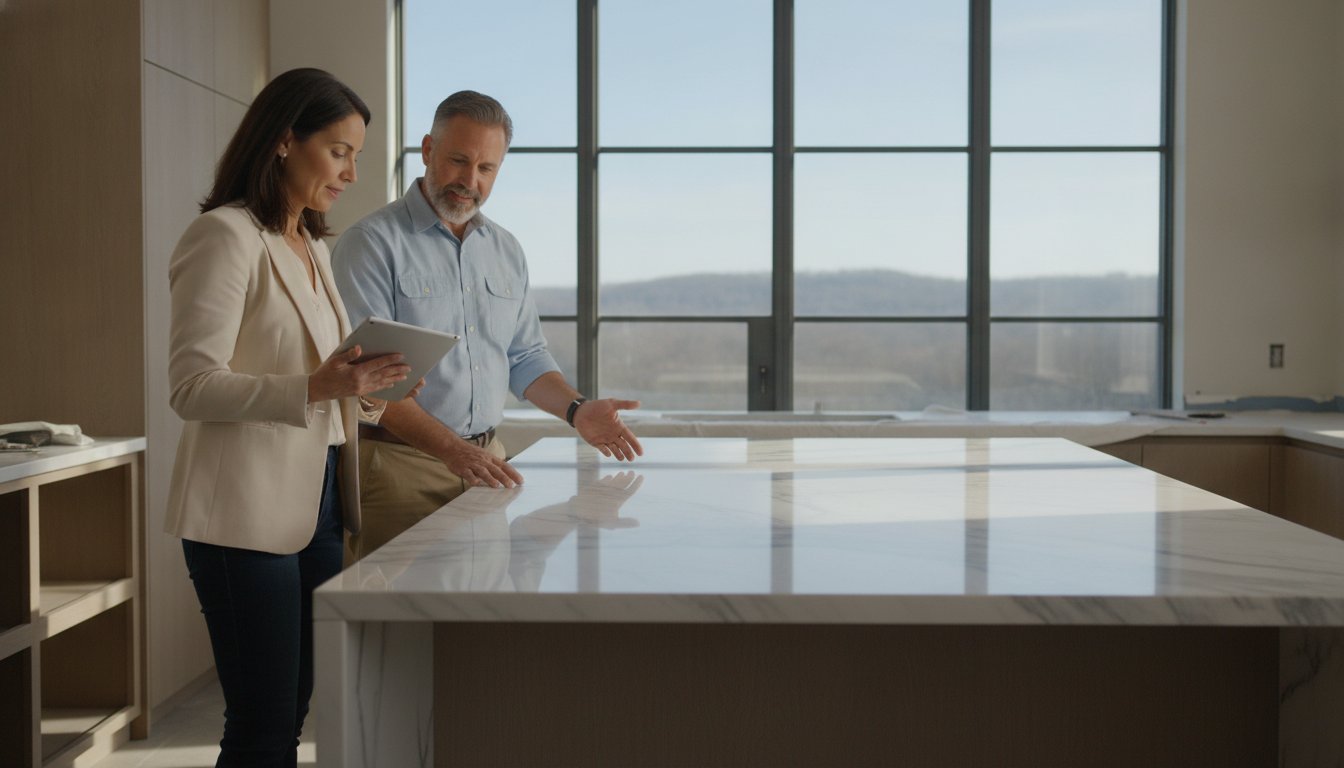
Precision is the hallmark of a master. After selecting your slab, we translate the unique geometry of your home into a digital CAD model with sub-millimeter accuracy. The granite fabrication process relies on this digital blueprint to bridge the gap between raw stone and your specific architectural environment. In the complex landscape of NYC and NJ architecture, walls are rarely perfectly square and floors often possess subtle undulations. Digital templating captures these nuances, ensuring that the stone fits with surgical precision. This meticulous accuracy at the blueprint stage is the only way to guarantee seamless transitions between your countertop and backsplash.
Laser Technology vs. Traditional Wood Templates
The evolution of measurement has moved beyond the limitations of traditional wood strips and glue. Digital laser scans provide superior detail, accounting for every faucet hole, sink cutout, and appliance clearance before the stone is even touched. During this scan, our technicians act as consultants. They identify potential structural challenges, such as cabinet leveling issues or wall irregularities, that might compromise the final result. As part of a prestigious network of countertop professionals, we understand that a flawless installation begins with an infallible map.
The Art of the Virtual Slab Layout
Perhaps the most artistic phase of the granite fabrication process is the virtual layout. We use specialized software to overlay your digital template onto high-resolution photographs of your specific slab. This allows us to visualize exactly where seams will fall before making a single cut. We invite you to participate in this ‘vein matching’ process, ensuring the stone’s natural movement flows elegantly across the surface. This is the essence of creating a custom countertop in Staten Island. We prioritize featuring the most dramatic veining in high-visibility areas like kitchen islands, turning geological history into a deliberate design statement.
Precision ensures your project moves forward without the anxiety of installation delays. If you’re ready to see how your vision translates to stone, explore our collection of natural elements to begin your journey.
The Transformation: Advanced Cutting and Structural Reinforcement
The moment the blade meets the stone is the most visceral stage of the granite fabrication process. It’s where the abstract digital blueprint becomes a physical reality. This transformation requires a delicate balance of brute power and surgical precision. We utilize advanced bridge saws equipped with diamond-tipped blades to execute the primary straight cuts. For the more complex elements of a design, such as intricate curves or precise sink cutouts, we employ high-pressure waterjet technology. These machines use a concentrated stream of water mixed with garnet abrasive to slice through the stone’s ancient density without the risk of heat-induced cracking.
Maintaining the stone’s thermal stability is a priority during these high-friction procedures. The interaction between a diamond blade and granite generates intense heat, which can lead to micro-fractures or permanent discoloration if not managed. Our facility utilizes a continuous water-cooling system that bathes the stone throughout the cutting arc. This preserves the material’s structural integrity and ensures the vibrant, natural colors of the minerals remain as vivid as the day the slab was quarried.
The Mechanics of the Modern Bridge Saw
A bridge saw isn’t merely a tool; it’s an instrument of precision. The artisan must calibrate the machine’s speed to match the specific hardness of the granite variety. Some exotic slabs are significantly denser than others, requiring a slower, more measured approach to produce the clean, crisp edges that characterize a luxury installation. This synergy between machine capability and human expertise ensures that every cut respects the stone’s natural grain and geological history.
Strengthening the Masterpiece
True craftsmanship involves preparing for the invisible stresses a countertop will face. We implement a technique known as ‘rodding’ to provide essential structural reinforcement. This process involves:
- Cutting narrow grooves into the underside of the stone in high-stress areas.
- Embedding high-strength steel or fiberglass rods into these channels.
- Securing the rods with specialized, industrial-grade epoxies.
This reinforcement is particularly critical around sink and cooktop cutouts, where the stone is thinnest. By reinforcing these narrow spans, we ensure the slab can withstand the rigors of transport through busy NYC streets and the final installation process. It’s a hidden layer of protection that guarantees the longevity of your kitchen surfaces, preventing cracks and ensuring your investment remains a permanent legacy of luxury.

Artisan Finishing: Where Nature Meets the Master’s Hand
While the bridge saw provides the geometry, the finishing stage of the granite fabrication process provides the soul. This is where the raw, industrial cuts are softened and refined by human touch, elevating the material into an architectural masterpiece. A master granite fabricator understands that nature’s work is only half the story; the other half is told through the meticulous refinement of every visible edge and surface. This phase is not an assembly line process but a disciplined sequence of stone refinement that respects the geological history of the slab.
The Nuances of Edge Craftsmanship
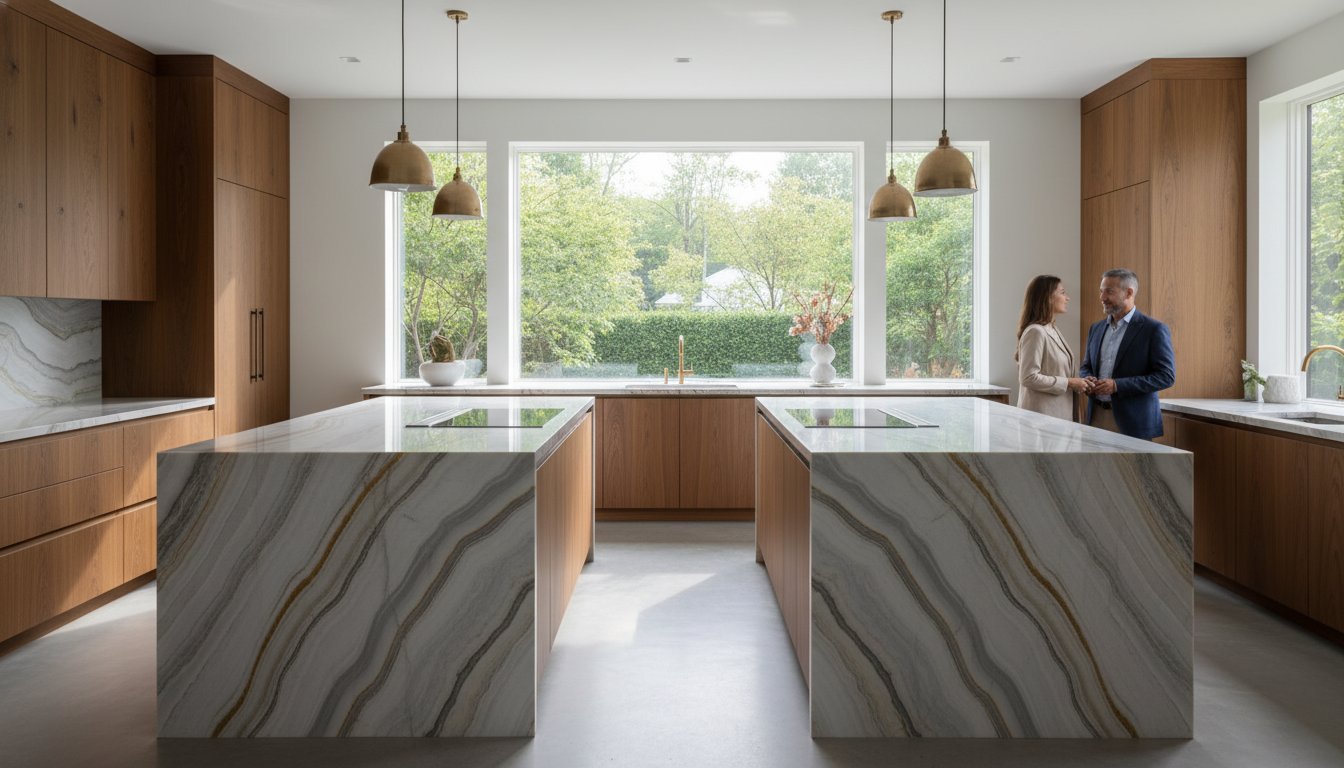
The edge profile serves as the definitive boundary of your design. For a modern NYC loft, a crisp, Eased edge offers a minimalist silhouette that emphasizes the stone’s thickness and clean lines. Conversely, a traditional NJ estate may call for the sophisticated curves of an Ogee or the dramatic continuity of a Waterfall design. Maintaining consistency across long runs and perfectly executing mitered corners are technical challenges that demand a steady hand and a keen eye. Custom edge work isn’t merely a finishing touch; it’s a design statement that transforms a utility surface into a curated work of art that feels permanent and stable.
The Polishing Gradient: From Honed to High-Gloss
Refining the surface requires a sequence of progressively finer diamond pads, moving from coarse grits to a delicate, mirror-like finish. While machines can handle flat expanses, hand-finishing remains the hallmark of true quality for intricate curves and internal corners where automated tools cannot reach. This manual dexterity is integral to the granite fabrication process, ensuring a uniform luster across the entire slab. We offer various textures to suit your aesthetic: polished for high-gloss brilliance, honed for a satin-like softness, or leathered. A leathered finish offers a tactile alternative to traditional gloss, inviting a sensory connection with the stone’s natural topography. Every piece concludes with a final inspection, a rigorous tactile and visual audit conducted by a senior artisan to ensure the finish meets our enduring standards of elegance.
If you’re ready to experience the difference that hand-finished artistry makes in your home, contact our Staten Island facility to discuss your custom project with a master artisan.
The Final Realization: Professional Installation and Sealing
The journey from our Staten Island facility to your residence is the definitive act of the granite fabrication process. In the unique landscape of New York City and Northern New Jersey, this phase requires more than technical skill; it demands a white-glove logistical strategy. Our teams are experts in navigating the complexities of high-rise elevators and narrow pre-war hallways with practiced poise. We use specialized transport frames and heavy-duty carts to ensure the stone’s structural integrity remains uncompromised until it reaches its final destination. This measured approach ensures that the masterpiece we’ve refined in the shop arrives at your home in pristine condition.
The Seamless Installation Experience
Once on-site, the focus shifts to achieving perfect architectural harmony. We perform precision leveling to ensure the stone sits perfectly flat on your custom kitchen cabinets. Even a minor deviation in the substrate can create stress points in the stone over time, so we take the time to shim and support the slab with absolute accuracy. The science of the seam is where our artistry becomes invisible. We utilize mechanical suction seam setters to pull the joints together while applying custom-pigmented resins that match the stone’s specific color palette. This results in nearly imperceptible joints that don’t disrupt the visual flow of the veining. Our installers also manage the final plumbing and appliance fit-outs, maintaining an immaculate and respectful job site throughout the day.
Long-Term Preservation and Care
The final step in our role as guardians of your stone is the application of a high-grade penetrative sealer. This isn’t a mere surface coating; it’s an invisible shield that bonds within the stone’s pores to repel moisture and prevent deep-seated stains. This treatment is essential for preserving the stone’s geological legacy against the rigors of daily life. We believe in empowering our clients through education, sharing simple rituals of stone care to ensure a lifetime of beauty. Using pH-neutral cleaners and avoiding harsh abrasives will keep the surface as vibrant as the day it was installed. The Richmond Stone commitment is a 30-year family-owned legacy of support, and we remain a trusted partner for our clients long after the final seal has dried. We don’t just deliver a countertop; we install a permanent legacy of luxury that transcends fleeting trends.
The Final Step Toward an Enduring Masterpiece
The transformation of raw geological history into a bespoke architectural centerpiece is a disciplined journey that requires both digital precision and manual artistry. We’ve explored how the granite fabrication process bridges the gap between the raw earth and the refined elegance of your residence. From the initial curation of the slab to the final application of a protective seal, every stage is executed with a reverence for the materials and a commitment to uncompromising quality. This meticulous sequence ensures that your countertop is not just a utility surface, but a permanent legacy of luxury.
For over 30 years, our family-owned authority has served as a premier guardian of natural elements across Staten Island, the NYC boroughs, and the NJ metro area. We bring a master artisan’s touch to every project, blending traditional heritage with modern innovation in stone and bespoke cabinetry. Your home is a reflection of your values, and it deserves a surface that stands as a testament to intrinsic artistry and stability. Begin your journey with a master artisan at Richmond Stone and discover how we turn geological wonders into curated masterpieces. We look forward to helping you create an environment that truly endures.
Frequently Asked Questions
How long does the entire granite fabrication process take?
The journey from digital templating to final installation typically spans seven to fourteen days. This timeline allows our master artisans to execute the meticulous refinement required for a bespoke architectural masterpiece. We prioritize precision over a rushed pace to ensure the stone’s geological integrity is preserved. While design complexity or exotic material sourcing can influence the duration, we maintain a steady rhythm that honors both the craft and your project’s schedule.
Can I choose exactly where the seams will be on my countertop?
You’re encouraged to participate in the digital layout phase to influence where seams are placed. We use specialized software to map your template onto the specific slab, allowing you to visualize how the joints will interact with the stone’s natural veining. While structural requirements and slab dimensions dictate certain technical limitations, our goal is to minimize visibility. We strive for a layout that ensures the most dramatic mineral patterns remain uninterrupted.
What is the difference between fabrication and installation?
Fabrication is the off-site refinement of the raw slab, while installation is the on-site placement of the finished surface. During the granite fabrication process, we cut, reinforce, and hand-polish the stone within our controlled Staten Island facility. Installation involves the logistical challenge of transporting these heavy elements to your home and securing them with surgical precision. Both stages are handled by our dedicated in-house experts to ensure a seamless transition from workshop to residence.
Is it necessary to be present during the templating process?
We require the homeowner or a primary decision-maker to be present during the templating appointment. This ensures that critical design nuances, such as overhang depths and seam locations, are discussed and approved on-site. Our technicians utilize laser equipment to create a digital model, but your personal vision is vital for a truly customized result. Being present also allows us to identify any structural cabinet irregularities that must be addressed before the stone is cut.
Does the fabrication process include cutting holes for my sink and faucet?
Every required cutout for sinks, faucets, and cooktops is executed with surgical precision during the fabrication stage. We use advanced waterjet technology to create these openings based on the exact specifications of your chosen appliances. These areas are further reinforced with internal rodding to ensure structural stability during transport. By completing this work in our facility, we maintain a clean environment in your home and guarantee that every component fits flawlessly upon installation.
Why is hand-finishing considered superior to machine-only polishing?
Hand-finishing provides a level of detail and tactile consistency that automated assembly lines simply cannot replicate. While machines handle broad, flat surfaces, a master artisan’s hand is required to polish intricate curves and internal corners where mechanical tools lose precision. This manual refinement ensures a uniform luster across the entire edge profile. It allows us to respond to the unique density of each slab, resulting in a finish that reflects the poise of true craftsmanship.
What happens if a slab breaks during the fabrication process?
In the rare event of a structural failure during fabrication, we take immediate responsibility for sourcing a replacement that matches your original selection. Natural stone can occasionally harbor hidden geological weaknesses that only reveal themselves under the stress of high-friction cutting. Because we manage the entire lifecycle of the project, we ensure that any material issues are resolved without compromising the quality of your final installation. Your investment is protected by our thirty years of expertise.
How do I prepare my kitchen for the templating and installation dates?
Preparation involves clearing all surfaces and ensuring your cabinetry is fully installed and leveled. For templating, countertops must be free of clutter so our lasers can capture sub-millimeter measurements. For installation, please create a clear path through your home for our team to navigate with the stone.
- Clear all items from existing countertops and surrounding work areas.
- Ensure all sinks and appliances are on-site for final verification.
- Secure pets and clear hallways of fragile decor or furniture.
This preparation ensures an efficient and respectful experience for your home and our artisans.