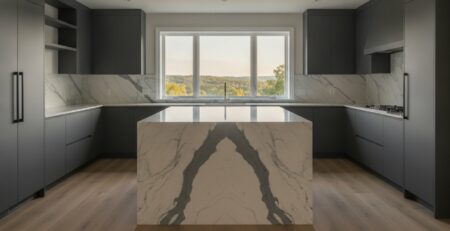

Where Does Marble Come From? From Ancient Rock to Finished Stone
What if the answer to “where does marble come from” begins millions of years before a quarry ever cuts a block? Marble has two origins: the geological process that forms it deep within the Earth, and the places where it’s later quarried, shaped, and brought into a home. The distinction matters because a stone’s birthplace and its visual character are related, but one doesn’t tell the whole story.
If you’ve admired marble’s veining and wondered what creates those patterns, or whether appearance alone can reveal a stone’s source, the answer lies in its history. Heat and pressure alter limestone or dolostone, while minerals in the original rock contribute to its colour and veining. Quarrying and skilled fabrication then carry each block toward a finished surface. Natural variation means no two slabs have precisely the same character. This guide follows that journey, from metamorphism and recrystallization to quarrying regions and the steps that turn a rough block into a countertop or other architectural feature.
Key Takeaways
- To understand where does marble come from, distinguish the underground geological process that forms it from the regions where it’s later quarried.
- Heat and pressure transform limestone or dolostone as minerals recrystallize into interlocking crystals. The rock doesn’t melt into a new material.
- Marble is quarried in several countries, and each origin offers distinct stone varieties and visual character.
- Following the journey from quarry block to finished slab shows how cutting and fabrication shape the stone without changing its geological origin.
- Assess a slab’s colour, veining, and natural variation against your project’s design and intended use.
Where Does Marble Come From? Begin with the Rock It Becomes
Marble forms underground when pre-existing carbonate rock is transformed by heat, pressure, or both. A metamorphic rock is an existing rock changed by conditions within Earth’s crust. So, where does marble come from? It forms through the geological alteration of rocks such as limestone or dolostone, not at the quarry. The quarry is where people later expose and extract the stone.
Marble is a metamorphic rock formed when limestone or dolostone changes within Earth’s crust. This definition separates the stone’s geological birthplace from the place it enters the supply chain. A quarry reveals marble that formed below ground; it doesn’t create the material.
What kind of rock is marble?
Geological marble is metamorphic, rather than simply any stone with a marble-like appearance. Its parent rocks are commonly limestone and dolostone, both carbonate rocks. Limestone is composed mainly of calcite, a mineral made of calcium carbonate. Dolostone is composed mainly of dolomite, a mineral containing calcium and magnesium carbonate. These terms describe the minerals and source rocks involved, not a surface finish or design style.
As heat and pressure alter the parent rock, its minerals reorganize and form a new crystalline texture. The geological definition of marble reflects this transformation. A veined or polished stone may look like marble, but appearance alone doesn’t establish its geological classification.
Where does marble form before it is quarried?
Marble forms within Earth’s crust, where carbonate rock encounters conditions powerful enough to change its mineral structure. This can happen when rocks are buried and subjected to pressure, or when heat from nearby molten rock alters them. The transformation unfolds over geological time. The precise setting varies, but the distinction is clear: formation happens below ground; quarrying happens later, when people reach and extract the stone.
- Geological birthplace: Beneath the surface, limestone or dolostone is altered by heat, pressure, or both.
- Quarry location: At a surface or excavation site, workers cut and remove marble that has already formed.
This distinction helps explain why a place name associated with marble usually refers to its quarrying region, not necessarily to a single formation event. The rock’s geological history precedes its extraction. Its colour and veining can reflect minerals and other material present in the original carbonate rock, which become part of the stone as it changes. The next part of the story looks at how geology varies from region to region and how those differences show up in quarried marble.
How Heat and Pressure Transform Limestone into Marble
Marble forms through gradual rearrangement, not by melting and recasting stone. Deep within Earth’s crust, heat and pressure change carbonate rock’s texture and mineral structure. The process is easier to understand by following its main stages.
- Parent rock: The process begins with limestone or dolostone, carbonate rocks made mainly of calcite or dolomite minerals.
- Metamorphic conditions: As the rock is buried or affected by heat from nearby geological activity, rising temperature and pressure alter its original structure. The rock remains solid.
- Recrystallization: Minerals reorganize into a tighter arrangement of interlocking crystals, changing the rock’s texture without turning it into molten material.
- Resulting marble: Once transformed, the rock is marble, with a crystalline structure and an appearance shaped by its mineral makeup and geological history.
What happens to limestone during metamorphism?
In limestone, calcite crystals can grow and interlock as the rock responds to heat and pressure below the surface. Original textures may become less distinct as the mineral grains reorganize. Dolostone can undergo a comparable transformation, with dolomite among the minerals in the resulting rock. The formation of marble from limestone depends on changes within the crust, not quarry cutting or polishing, which happen much later.
In marble formation, recrystallization is the process by which minerals reorganize into interlocking crystals while the rock remains solid. Marble is changed by metamorphism; it isn’t created by melting limestone and letting it cool.
Why do marble crystals, veins, and colours vary?
The finished texture reflects the conditions the parent rock experienced. Crystal size can vary with the intensity and duration of metamorphism, though appearance alone doesn’t reveal a precise geological history. Mineral content also contributes to colour and pattern. Clay-rich material may lend tan or grey tones; iron oxides can contribute reddish or brown shades, while graphite may create darker markings.
Imagine two areas of carbonate rock with different mineral traces. After metamorphism, one might yield a pale stone with fine grey patterning, while the other could show warmer streaks or darker accents. These are illustrative possibilities, not a rule that assigns each colour to one place. Veining and colour help describe a slab’s individual character, but they can’t reliably identify its quarry on their own.
Natural variation is part of what makes marble distinctive as a surface material. If you’re considering marble for a project, explore marble surface options with the stone’s pattern, colour, and intended use in mind. Next, follow the journey from the conditions that form marble to the regions where it’s quarried.
Where Is Marble Quarried Around the World, and Why Do Origins Differ?
The question “where does marble come from” has two distinct answers: the geological setting where the rock formed and the region where people later quarry it. Marble is extracted in multiple countries. Names used for particular stones can refer to a quarrying region, a commercial variety, or an established name. These clues are useful, but they don’t always provide a complete record of an individual slab’s path.
How geography relates to marble varieties
Quarrying regions are associated with particular marble names, but a name’s meaning depends on how it’s used. Carrara, for example, refers to a marble-producing area in Italy as well as to marble associated with that area. Not every white marble comes from Carrara, and colour or veining alone isn’t reliable proof of origin. The examples below show how regional and commercial labels may relate.
| Region | Stone name | Sourcing context |
|---|---|---|
| Carrara, Italy | Carrara marble | Marble quarried in the Carrara area of Tuscany. |
| Thassos, Greece | Thassos marble | A named marble associated with quarrying on the island of Thassos. |
| Makrana, Rajasthan, India | Makrana marble | A regional marble name linked to quarrying in the Makrana area. |
| Vermont, United States | Danby marble | A named marble quarried in Vermont. |
What does a marble origin name tell you?
Separate three kinds of information: the country or region of extraction, the commercial variety name, and the stone’s geological formation. They’re related, but they aren’t interchangeable. Geological history describes how the parent rock changed; a quarry location identifies where it was extracted; a trade name may reflect regional tradition or commercial usage.
A marble variety name can suggest a regional or commercial association, but it doesn’t always establish the quarry of an individual slab. That distinction matters when interpreting labels. A name such as Carrara gives meaningful context because Carrara is a recognized marble-producing region, but it doesn’t mean all white marble comes from there. As Britannica explains in its account of the metamorphic process of marble formation, geological formation is separate from later extraction and naming.
Use origin labels as a starting point, not a full geological record. A label may help identify a stone’s established regional or commercial identity, while the slab itself reveals its individual pattern, colour, and variation. Understanding a specific slab’s provenance requires information about its sourcing, not an assumption based only on its appearance or familiar name.

From Marble Quarry to Slab: Follow the Stone’s Journey
Marble’s geological history is only the beginning. The stone must be extracted, prepared, cut into slabs, selected, and shaped for its intended setting. Each step changes its format or finish, not where the marble formed. Knowing the difference helps clarify what a quarry name, slab label, or finished surface can tell you about its journey.
How quarry blocks become usable slabs
At the quarry, workers separate blocks from the surrounding rock and prepare them for transport and further processing. A block is then cut into slabs of a chosen thickness. The cut reveals a broad face of the stone, bringing its natural veining, colour, and crystal texture into view. Finishing can refine the surface and influence how those features appear, but it doesn’t create the patterns within the marble.
From there, the stone moves through steps that prepare it for a specific project:
- Quarry extraction: Marble is separated from the rock formation as large blocks.
- Block preparation and cutting: Blocks are prepared for processing and sawn into slabs.
- Slab selection: The visible pattern, colour, and natural variation are considered for the intended design.
- Templating and fabrication: Project measurements guide how the chosen stone is cut and finished for its final application.
- Installation: Fabricated pieces are fitted into the space as a countertop or other surface.
Quarrying and project fabrication are distinct parts of this chain. The quarry produces and prepares stone blocks; later, specialists measure the space, plan the cuts, fabricate the pieces, and install them. Richmond Stone provides material sourcing, templating, fabrication, and professional installation, bringing skilled work to the transition from natural material to finished surface.
How to understand a slab’s provenance
Provenance means information about a material’s origin and path. Depending on the supplier and records available, documentation may identify a country or quarry region, a commercial variety name, or other sourcing details. The level of detail can differ, so don’t assume every slab comes with a complete geological or transport history.
A familiar variety name can offer useful context, but it doesn’t necessarily identify the precise quarry or route taken by an individual slab. Fabrication can’t establish provenance either: a polished finish or custom edge describes later workmanship, not geological origin. For broader context on how natural materials carry their own histories into design, explore the natural stone guide.
For a marble surface shaped around your project, explore marble countertop options and consider how the slab’s individual character will read in the finished space.
Bring Marble’s Natural Origins into a Thoughtful Surface Choice
Understanding where marble comes from gives each slab context, but choosing one is ultimately a visual and practical decision. Its geological history appears in the details: the movement of its veining, the balance of light and dark, and the subtle differences across the stone. Consider how those features will work in your space rather than expecting a perfectly uniform surface.
What to notice when viewing marble for a project
Whenever possible, view the slab itself, not only a small sample or photograph. A small piece can suggest the marble’s colour and pattern, but it may not show how the veining moves across a full surface or how natural variation is distributed. Look at the stone from different angles and consider how its larger pattern will relate to the room.
For a kitchen countertop, consider whether prominent veins will complement the cabinetry and surrounding finishes. For a bathroom vanity, you might prefer a quieter pattern or welcome more expressive movement. Neither choice is inherently better. The right slab is the one whose character suits the project and the look you value.
Natural stone varies, so a finished surface may not look exactly like a photograph or small sample. That individuality is part of marble’s appeal. Discuss how the selected slab will be laid out and fabricated, including which visible areas matter most to your design. The transition from stone selection to a carefully shaped surface is part of custom countertop craftsmanship.
How Richmond Stone carries natural stone into a finished project
Once you know what patterns and colours appeal to you, the next step is planning how the material will become part of your space. Richmond Stone is a family-owned business with over 30 years of experience in stone and surface projects. Its services include material sourcing, templating, fabrication, and professional installation, connecting the individuality of natural marble with the measurements and details of a finished project.
The Richmond Stone marble catalog lists 105 products. A catalog listing doesn’t mean every slab is currently in stock, and inventory can change. Before making a purchase decision, review the specific slab’s visible character and confirm current inventory and availability with a salesperson. Richmond Stone’s showroom is at 236 Richmond Valley Rd, Staten Island, NY 10309. Call (347) 215-2719 to speak with the team.
For a marble project, request a free estimate and confirm current inventory and availability with a salesperson. Careful selection, measurement, and fabrication help bring the stone’s natural character into a surface made for your space.
Choose the Marble That Feels at Home in Your Space
The question “where does marble come from” has a lasting answer in every slab: its character carries a history shaped by nature, then refined for a particular setting. As you consider your project, look beyond the name on a label. Picture how the stone’s movement and tonal variation will sit alongside the room’s materials, light, and everyday use. The right choice is the one that feels considered in the space you’re creating.
When you’re ready to explore, Richmond Stone can help carry your marble selection toward a finished surface. Explore marble surfaces and request a free estimate, then confirm current inventory and availability with a salesperson. Visit the showroom at 236 Richmond Valley Rd, Staten Island, NY 10309, or call (347) 215-2719.
Let the stone’s natural individuality guide a design that feels distinctly yours and is made to be appreciated for years to come.
Frequently Asked Questions
Is marble always made from limestone?
No. Marble can form from limestone or dolostone, a carbonate rock rich in the mineral dolomite. The resulting stone’s mineral composition depends partly on its parent rock, so not every marble has precisely the same makeup. Geological names can clarify what a material is, while a commercial label may describe a familiar variety. A stone’s appearance alone doesn’t confirm which parent rock formed it.
Can fossils survive the formation of marble?
Sometimes traces may remain, but fossils often become difficult to recognize as carbonate minerals recrystallize during metamorphism. The outcome depends on the conditions the rock experienced and the fossils’ original form. A swirling feature in a slab shouldn’t automatically be identified as a fossil; mineral veining and crystal patterns can also create intriguing shapes. If fossil preservation matters to your project, look for geological documentation specific to the stone rather than relying on visual resemblance.
Is marble quarried in the United States?
Yes. Marble is quarried in the United States, including Danby marble from Vermont and Yule marble from Colorado. These names connect particular stones with recognized American quarrying regions, but they don’t represent every domestic source. When comparing a U.S.-quarried slab with an imported one, consider the material and its documentation alongside its appearance. A country label alone doesn’t explain a slab’s full sourcing history.
How can I find out where a marble slab was quarried?
Start with the slab’s label and any supplier documentation, looking for a quarry region or country rather than relying on the variety name alone. Find out what the name identifies: a particular source, a broader region, or a commercial stone type. Documentation varies, and some records may not establish an individual slab’s precise quarry or transport route. Keep the label or paperwork with your project records for future reference.
Does marble form underground or at the surface?
Marble forms underground, within Earth’s crust, as existing carbonate rock changes under geological conditions. A quarry is a later excavation that exposes and removes the already-formed stone. This distinction explains descriptions such as “formed in one geological setting, quarried in another region.” Cutting, polishing, and fabrication happen after extraction, so a finished countertop’s shape and finish don’t indicate where its marble originally formed.
Is marble a renewable natural resource?
No, marble is generally considered nonrenewable on human timescales. Although natural geological processes can create marble, they occur over periods far beyond the pace of human use, and quarrying removes stone from a finite formation. A considered selection can help the material serve its intended purpose for years. The stone’s natural variation also means thoughtful layout can make use of the character present in the chosen slab.
Are all stones sold as marble geologically marble?
No. In geology, marble refers to metamorphosed carbonate rock, primarily derived from limestone or dolostone. In commerce and design, “marble” may also be used more loosely for stones with a similar veined or polished appearance. A product name alone may not settle its geological classification. If the distinction matters, check the material description or available technical documentation, and consider mineral composition rather than appearance alone.