

How Often Do You Need to Seal Granite? A Master Artisan’s Guide to Stone Preservation
If a piece of granite has survived for millions of years beneath the earth’s crust, why should a single glass of spilled Cabernet Sauvignon pose a threat to its legacy? Many homeowners find themselves paralyzed by conflicting advice when asking how often do you need to seal granite to protect that ancient beauty. It’s understandable to feel a sense of stewardship, perhaps even anxiety, over the deep luster of your kitchen’s centerpiece. You’ve invested in a material that defines your home’s character, and the fear of a permanent oil stain or a dulling finish is a heavy burden for any lover of natural artistry.
This guide provides the definitive clarity you seek, moving beyond generic calendars to offer a preservation strategy tailored to the unique geological makeup of your specific slab. We’ll explore how stone density and your individual lifestyle dictate a precise maintenance rhythm, ensuring your surfaces remain a timeless legacy. From the simple water test to the nuances of high-traffic culinary spaces, you’ll gain the confidence to preserve your stone’s value for decades to come. True luxury isn’t rushed, and your maintenance routine should be as measured and deliberate as the craftsmanship that brought the stone into your home.
Key Takeaways
- Understand how the geological density of your specific slab dictates a personalized maintenance schedule, moving beyond generic calendar recommendations.
- Learn how often do you need to seal granite by performing the Artisan’s Water Drop Test to accurately assess the integrity of your stone’s protective barrier.
- Identify why high-porosity selections, such as white or cream granites, typically require a more frequent resealing window of six months to one year.
- Master the daily preservation rituals and the “Golden Rule” of stone care, which avoids acidic or abrasive cleaners that can compromise your granite’s natural luster.
- Discover how professional fabrication and meticulous initial sealing provide the necessary foundation for a lifetime of enduring elegance and value.
The Architecture of Stone: Understanding Porosity and the Need for Preservation
Granite is a masterpiece of deep-time pressure and volcanic heat. It’s a crystalline, porous natural element that commands respect in any architectural setting. While it feels impenetrable to the touch, its igneous rock composition contains an intricate network of microscopic pathways. These pores are the stone’s primary vulnerability. Without a high-grade protective barrier, liquids don’t simply sit on the surface; they migrate into the stone’s heart. This internal absorption leads to deep-seated staining or bacterial growth within the kitchen’s most utilized surfaces, turning a focal point into a liability.
Think of a professional sealer as an invisible shield. It doesn’t alter the stone’s appearance, but it preserves its intrinsic artistry. Many homeowners find themselves asking how often do you need to seal granite, but the answer begins with understanding that sealing is deep-tissue preservation. Surface-level cleaning merely removes daily debris. Sealing, however, prevents permanent alteration of the stone’s geological history. It’s the critical difference between a temporary shine and an enduring legacy that lasts for generations.
Why Natural Stone ‘Breathes’
Every slab tells a specific story of its origin. Formed from cooling magma, the mineral composition of granite varies wildly between different quarries and even different sections of the same mountain. This variation is why two pieces of stone might look similar but exhibit entirely different absorption rates. One slab may be naturally dense and resistant, while its neighbor is thirsty for protection. Porosity refers to the percentage of void space within the stone’s crystalline structure, determining its capacity to absorb foreign substances.
The Consequences of Neglect
Neglect manifests in subtle, frustrating ways. You might notice a slight darkening after a routine spill or a gradual loss of the stone’s natural luster. Over time, trapped moisture can compromise the structural integrity of the stone, leading to micro-fissures that develop over decades. In the prestigious homes of NYC, a pristine kitchen environment is more than a utility; it’s an emotional sanctuary. A stained countertop isn’t just a maintenance failure. It’s a blemish on the home’s heritage and a quiet erosion of its market value. Understanding how often do you need to seal granite is the first step in halting this decline and protecting your investment.
Calculating the Interval: Why Stone Density Dictates Your Sealing Schedule
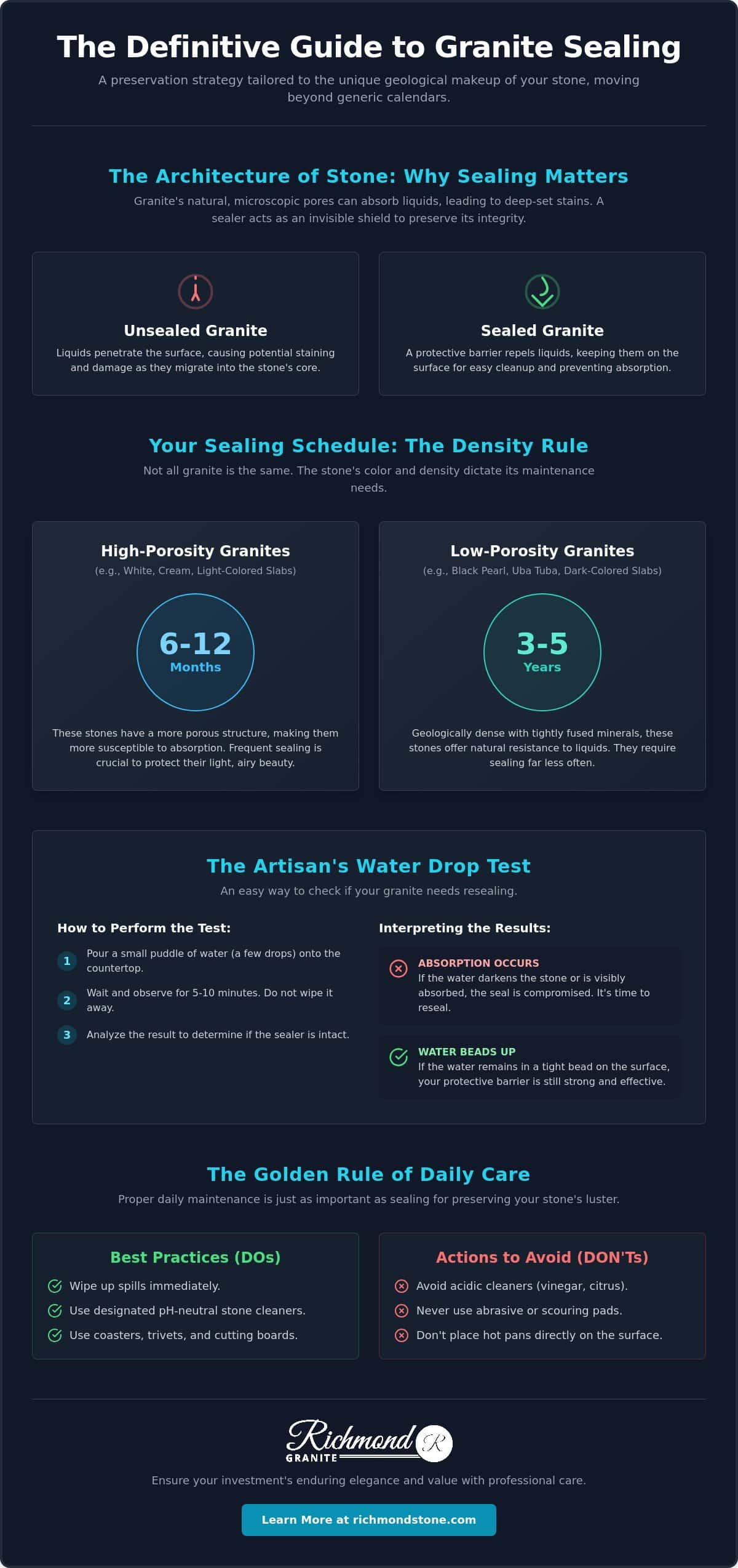
The most common misconception in stone preservation is the belief that all granite follows a singular, universal calendar. In reality, the geological fingerprint of your specific slab is the only reliable guide. Master artisans rely on the “Density Rule” to determine maintenance cycles. Lighter granites, such as those with airy white or cream complexions, possess a more porous crystalline structure. These high-porosity stones typically require a sealing window of six months to one year to ensure liquids remain on the surface rather than migrating into the stone’s heart. Understanding how often do you need to seal granite requires looking past the surface to the geological reality of the slab.
When you ask how often do you need to seal granite, you must first identify where your stone sits on the color and density spectrum. Darker variants, such as Uba Tuba or Black Pearl, are geologically distinct. Their minerals are fused so tightly that they offer a natural, stoic resistance to liquid penetration. For these dense surfaces, a professional seal may only be necessary every three to five years. This tailored approach respects the intrinsic nature of the material while providing the homeowner with a realistic, manageable preservation plan that avoids unnecessary chemical applications.
Light vs. Dark Granite: A Geological Comparison
Modern NYC designs frequently favor light-colored slabs for their ability to reflect light and create a sense of expansive luxury. These stones, while breathtaking, are the most susceptible to the “wicking” of oils and pigments. Conversely, darker stones possess a natural density that acts as a primary defense. Homeowners should categorize their stone into tiers. A high-maintenance tier for light, porous slabs and a lower-maintenance tier for dark, compact stones ensures that care is always proportional to the stone’s needs and geological strengths.
The Impact of Daily Use on Sealer Longevity
The “Staten Island Lifestyle” often centers around the kitchen as a place of vibrant gathering and sophisticated culinary creation. High-heat cooking and the inevitable splash of acidic ingredients can degrade a sealer’s integrity much faster than a quiet “show kitchen” that rarely sees a pan. If you’re managing high-traffic outdoor kitchen surfaces in New Jersey, the added exposure to UV rays and temperature fluctuations necessitates even closer attention. Following authoritative guidance on stone care helps you recognize that a sealer is a sacrificial layer. It’s designed to wear so the stone doesn’t have to. If you’re ready to elevate your home with a surface built for both beauty and endurance, explore our expertise in custom countertops in Staten Island to find a slab that fits your lifestyle perfectly.
The Artisan’s Test: How to Determine if Your Granite Requires Resealing
While geological density provides a sophisticated baseline for maintenance, the true state of your stone’s protection is revealed through direct observation. You don’t need complex machinery to uncover the truth of your countertop’s health. The Water Drop Test remains the definitive, time-honored method used by master artisans to assess sealer integrity with absolute precision. By performing this simple check every six months, you stay ahead of potential damage and eliminate the guesswork of how often do you need to seal granite. It’s a proactive ritual that ensures the sacrificial barrier remains intact before the stone’s heart is ever at risk.
Execution is paramount. You must focus your attention on high-use areas where the sealer faces the most frequent erosion. The zones surrounding your sink, where water splashes are constant, and your primary food preparation surfaces, which endure the friction of daily culinary activity, are the first places the protective shield will thin. This university resource explains the scientific concept of porosity and reminds us that even the most compact igneous rocks possess microscopic voids. These voids are what we aim to keep filled and protected through regular testing and timely intervention.
Performing the Water Drop Test Like a Pro
To achieve an accurate reading, follow a disciplined protocol that mirrors the precision of a master fabricator. Begin by thoroughly cleaning and drying a six-inch section of the countertop, ensuring no residual oils or moisture remain from recent use. Once the surface is pristine, place a tablespoon of room-temperature water directly onto the stone and start a 15-minute timer. During this window, observe the interaction between the liquid and the stone’s surface. You’re looking for the tension of the water. Does it bead tightly like a pearl, or does it begin to flatten and lose its shape?
Interpreting the Results: Actionable Outcomes
The visual cues provided by the water offer a clear directive for your next steps. If the water absorbs into the stone in under five minutes, creating a telltale dark spot, your granite is in immediate need of resealing. This rapid penetration signals that the previous barrier has vanished, leaving the crystalline structure vulnerable to permanent staining. Conversely, if the water is still beading prominently after 15 minutes, you’re in the ‘Safe Zone.’ This indicates a robust seal that continues to repel contaminants with ease. Documenting these results twice a year allows you to create a customized maintenance history for your home, providing the quiet confidence that your kitchen’s legacy is being preserved with meticulous care. Knowing how often do you need to seal granite becomes a matter of empirical evidence rather than mere estimation.
Maintaining Permanent Elegance: Best Practices for Granite Care in 2026
The preservation of a natural masterpiece requires more than occasional intervention; it demands a philosophy of care that respects the stone’s chemical composition. While we’ve established how often do you need to seal granite based on its geological density, the true lifespan of that seal is determined by your daily rituals. A sophisticated maintenance routine acts as a force multiplier for the initial sealer, extending the window of protection and ensuring the surface remains a pristine sanctuary. In 2026, the discerning homeowner understands that high-end stone care is less about labor and more about the intelligent selection of materials and methods.
The “Golden Rule” of stone preservation is the absolute avoidance of acidic or abrasive agents. Common household staples like vinegar, lemon juice, and bleach are the natural enemies of a professional-grade seal. These substances don’t just sit on the surface; they chemically dismantle the protective barrier, leaving the crystalline structure vulnerable to the very stains you seek to prevent. Your choice of cleaning agent directly influences how often do you need to seal granite, as a pH-neutral cleaner preserves the shield’s integrity for years, whereas harsh chemicals can strip it away in a matter of months.
Daily Rituals for Stone Longevity
Precision is everything in a high-traffic kitchen. Immediate spill management is the most effective way to protect your investment, particularly when dealing with cooking oils or pigmented liquids like red wine. We recommend using soft microfiber cloths to maintain the stone’s polish; these fibers lift debris without creating the micro-scratches that can dull a finish over time. Integrating these subtle habits into your Exquisite Kitchen Remodel Ideas for 2026 ensures that your design vision remains untarnished by the wear of daily life.
Choosing the Right Sealing Agent
Not all protection is created equal. Topical sealers merely create a temporary film on the surface that is prone to peeling and clouding. We advocate for the use of professional-grade impregnating sealers. These advanced solutions migrate deep into the pores of the natural stone, bonding with the minerals to repel liquids from the inside out. This internal defense is essential for a flawless finish that respects the stone’s ability to “breathe” while providing an uncompromising barrier against contaminants. If you’re seeking to secure the future of your architectural features, our collection of premium Granite Countertops offers the perfect union of raw beauty and expertly applied protection.
Beyond the Surface: Professional Fabrication and Lifelong Maintenance
The enduring beauty of a natural surface is a collaborative effort between the earth’s creation and the artisan’s hand. While the question of how often do you need to seal granite is essential for ongoing maintenance, the foundation of that longevity is laid during the initial fabrication process. A stone that’s poorly prepared or inadequately sealed at the outset will always struggle against the elements of a busy home. By contrast, a professionally installed surface from the start minimizes future burdens, allowing the stone’s natural artistry to shine without constant anxiety over its vulnerability.
At Richmond Stone, our 30-year legacy is built on the belief that we’re guardians of these natural elements. Every slab undergoes a rigorous preparation phase where it’s factory-sealed with premium, industrial-grade agents before it ever enters your home. This level of precision ensures that the stone’s crystalline structure is saturated and protected from day one. For those navigating the complexities of more reactive materials like quartzite or marble, our professional consultation provides a level of insight that off-the-shelf advice simply can’t match.
The Richmond Stone Advantage
Our fabrication process is a study in meticulous detail. We utilize high-performance impregnating sealers that offer a depth of protection far exceeding retail surface sprays. This commitment to quality is why our granite fabricator near me services are the preferred choice for NYC residents who value both aesthetic brilliance and structural permanence. Each project receives bespoke maintenance guidance, ensuring your care routine is as unique as the mineral veins in your countertop.
Investing in Enduring Quality
Superior installation is the ultimate investment in your home’s heritage. When you choose a master’s touch for your custom countertops Staten Island, you’re not just buying a surface; you’re securing a legacy. We invite you to view stone care not as a chore, but as an act of stewardship for a natural masterpiece. By understanding how often do you need to seal granite and following a professionally curated plan, you ensure your natural surfaces remain a timeless focal point. Consult with our experts today to develop a personalized care strategy that honors the intrinsic value of your stone for decades to come.
Securing the Future of Your Natural Masterpiece
Preservation is a journey of stewardship rather than a fixed destination. By understanding the intrinsic porosity of your slab and adopting the Artisan’s Water Test, you move beyond guesswork. You no longer need to wonder how often do you need to seal granite because the stone itself provides the answer through its daily interaction with your lifestyle. This mindful approach ensures that the deep luster and structural integrity of your surfaces remain untarnished for generations, reflecting the permanence of the earth from which they were born.
True luxury is built on a foundation of expert craftsmanship and enduring quality. With over 30 years of family-owned excellence, Richmond Stone combines master artisan fabrication in Staten Island with a deep reverence for the materials we handle. We take pride in serving NYC and NJ with bespoke stone solutions that transcend fleeting trends. Whether you’re maintaining a cherished heirloom or embarking on a new architectural vision, our expertise is your most trusted ally in creating environments of lasting prestige.
Schedule Your Design Consultation with Our Stone Experts to ensure your home’s heritage is preserved with the care it deserves. Your stone has a story; let’s work together to ensure it remains a masterpiece for a lifetime.
Frequently Asked Questions
Can I over-seal my granite countertops?
You can indeed over-seal your granite, leading to a cloudy or hazy residue that obscures the stone’s natural brilliance. When the microscopic pores are fully saturated, any additional product remains on the surface, where it dries into a stubborn film. Instead of following a rigid calendar, use the water test to determine how often do you need to seal granite, ensuring you only apply protection when the stone truly requires it.
What happens if I forget to seal my granite for several years?
Neglecting your sealing schedule for several years leaves the stone’s crystalline structure vulnerable to deep-tissue penetration from oils and acids. Over time, these substances migrate into the pores, causing permanent darkening or bacterial growth that surface cleaning cannot resolve. While the stone remains structurally sound, the aesthetic damage to its legacy can be profound, often requiring professional restoration to reclaim its original luster.
Is there a difference between sealing granite and sealing marble?
While both are natural elements, marble is a metamorphic rock that is significantly more porous and chemically sensitive than granite. Marble requires more frequent sealing and specialized agents to guard against etching, a physical dulling caused by acidic reactions. Understanding how often do you need to seal granite involves recognizing its superior natural density, whereas marble demands a much more vigilant and protective maintenance rhythm to survive daily use.
Do dark granite countertops like Black Absolute ever need sealing?
Extremely dense, dark granites often possess a mineral structure so compact that they effectively repel liquids without any chemical assistance. In many cases, applying sealer to these surfaces is counterproductive, as the product cannot penetrate the stone and simply creates a streak-prone film. Always perform a water test on dark slabs; if the water beads indefinitely, the stone’s natural architecture is already providing an impenetrable shield.
Can I use natural oils to seal my stone surfaces?
Natural oils should never be used as a substitute for professional-grade impregnating sealers. While oils might temporarily darken the stone, they eventually go rancid within the pores and attract debris, leading to a dull, unhygienic surface. True preservation requires a sophisticated sealing agent designed to bond with the minerals, providing a breathable yet resilient barrier that organic substances simply cannot replicate.
How do I know if my granite was sealed properly during installation?
The most reliable way to verify the integrity of an initial seal is to perform the water drop test immediately after installation. A master artisan’s work will cause water to bead tightly on the surface for at least fifteen minutes without any darkening of the stone underneath. If the liquid flattens or begins to soak in within moments, the initial application was insufficient and requires immediate professional attention to secure the stone’s future.
Will sealing my granite make it 100% stain-proof?
No sealer can make natural stone 100% stain-proof; rather, it makes the surface highly stain-resistant by providing a critical window of time to clean spills. A high-quality seal acts as a sacrificial barrier that slows the absorption of contaminants. Even with a robust seal, acidic liquids like lemon juice or red wine should be removed promptly to prevent the chemical breakdown of the protective shield and potential damage to the underlying minerals.
Is professional sealing worth the cost compared to DIY kits?
Professional sealing offers a level of precision and product potency that retail DIY kits rarely achieve. Master fabricators utilize industrial-strength impregnating agents that penetrate deeper into the stone’s heart, offering years of protection rather than months. While a DIY approach is suitable for minor touch-ups, a professional application ensures the stone is saturated correctly without leaving a hazy residue, preserving the intrinsic value of your investment for decades.