Quartz vs. Quartzite Countertops: The Master Artisan’s Guide to Selection (2026)
Is your kitchen destined to be a gallery for the raw, untamed history of the earth, or a testament to the flawless precision of modern engineering? The choice between quartz vs quartzite countertops is rarely a matter of simple utility. It’s an exploration of how you wish to interact with the spaces that define your life. You likely feel the weight of this decision, perhaps fearing that a naming confusion might lead to a material that stains or scorches under the pressure of a busy home. We understand that you seek a surface that commands respect while offering the resilience required for your daily rituals.
This guide reveals the definitive differences between nature’s metamorphic masterpiece and human-engineered precision, helping you choose the perfect surface for your environment. We’ll examine the geological soul of quartzite and the artisanal refinement of modern quartz, providing a clear decision framework based on your unique lifestyle. By the end, you’ll possess the clarity and confidence to invest in a masterpiece that resonates with your home’s character and stands as a lasting legacy of uncompromising quality.
Key Takeaways
- Contrast the geological soul of natural metamorphic rock with the controlled reliability and predictable performance of high-performance resins.
- Identify the critical thermal limits of engineered stone and why quartzite remains the premier choice for high-heat environments.
- Navigate the aesthetic nuances of quartz vs quartzite countertops to find the balance between organic, marble-like veining and modern, minimalist finishes.
- Uncover the technical complexities of the fabrication process, including why certain materials demand specialized diamond tooling for a flawless installation.
- Apply a lifestyle-based decision framework to ensure your selection aligns with your tolerance for maintenance and your kitchen’s daily demands.
The Metamorphic Legacy vs. Engineered Precision: Defining the Core
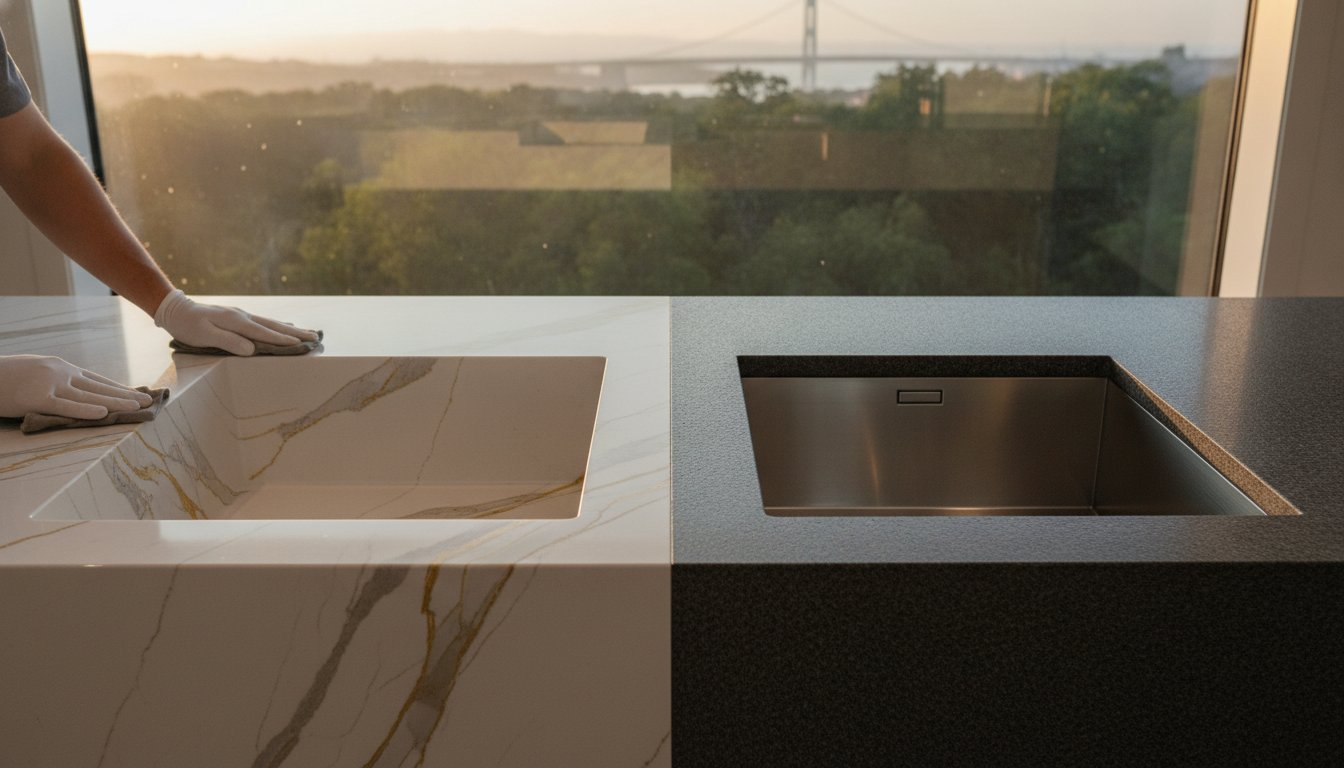
The choice between quartz vs quartzite countertops represents the fundamental intersection of nature’s raw power and human refinement. For many homeowners, the similarity in their names creates a persistent fog of confusion. It’s vital to recognize that while they share a mineral foundation, their paths to your kitchen are entirely different. One is a raw geological legacy. The other is a refined industrial achievement.
Quartzite: The Raw Artistry of Nature
Quartzite is a natural metamorphic rock forged deep within the earth’s crust. It begins its journey as humble sandstone. Through the violent, silent forces of tectonic heat and pressure, the sand grains recrystallize and fuse into an incredibly hard, dense structure. Because it’s a direct product of the earth, each slab carries a unique geological fingerprint. No two pieces are ever identical. Sourcing these slabs from global quarries is an exercise in curation, as the organic movement and crystalline depth of quartzite cannot be replicated by any machine. It’s a material for those who value the intrinsic artistry and heritage of the natural world.
Quartz: The Science of Consistency
In contrast, quartz is a sophisticated Engineered stone designed to provide predictable performance without sacrificing elegance. This material is meticulously manufactured by combining approximately 90-93% crushed natural quartz minerals with high-performance polymer resins. This scientific approach allows for the introduction of specific pigments, enabling the creation of surfaces that mimic the look of rare, fragile marbles with far greater resilience.
The primary advantage of this engineering is the absolute control over the final aesthetic. While natural stone is subject to the whims of geology, quartz offers a steady, rhythmic consistency. This uniformity is particularly valuable for expansive projects, such as custom countertops Staten Island, where multiple slabs must align perfectly to create a seamless visual flow. It’s a modern innovation that respects the beauty of minerals while optimizing them for the rigors of a contemporary home. Choosing between quartz vs quartzite countertops ultimately means deciding between a unique piece of Earth’s history or a high-performance surface tailored to your exact design specifications.
Performance Under Pressure: Durability, Heat, and Maintenance
A countertop is more than a visual centerpiece; it’s a silent partner in the demanding theatre of the kitchen. When evaluating quartz vs quartzite countertops, the distinction lies in how each material responds to the physical stresses of heat, impact, and moisture. Quartzite possesses an uncompromising structural integrity that often surpasses granite on the Mohs scale of mineral hardness, typically reaching a level 7. This makes it exceptionally resistant to scratches from stainless steel knives and heavy cookware. Engineered quartz, while equally resilient against daily wear, relies on a different structural logic that prioritizes impact resistance over raw geological hardness.
Heat Resistance: The Deciding Factor for Chefs
For those who practice the culinary arts with intensity, heat management is paramount. Quartzite is a champion of thermal stability. Because it’s forged in the earth’s furnace, it can withstand high temperatures without structural compromise or surface damage. Conversely, the high-performance resins in engineered quartz are sensitive to thermal shock. When exposed to temperatures exceeding 300 degrees Fahrenheit, these binders can scorch or suffer permanent discoloration. We recommend the consistent use of trivets for both materials to preserve their pristine finish, though quartzite offers a wider margin of safety for the occasional hot pan placed in haste.
Stains and Sealing: The Maintenance Reality
The daily ritual of care differs significantly between these two surfaces. Quartz is a non-porous champion. Its engineered composition creates a surface that requires zero sealing for the duration of its life, making it nearly impervious to wine, lemon juice, or oils. In contrast, even the most exquisite natural stone requires a degree of stewardship. Quartzite is naturally porous and necessitates periodic sealing to prevent etching or deep-seated staining. Modern nano-sealants have simplified this process, turning a once-cumbersome chore into a swift, semi-annual ritual that protects your investment from the inside out.
Choosing the right surface requires balancing these functional realities with your personal kitchen habits. If you value a maintenance-free existence, the engineered precision of quartz is unmatched. If you seek the raw, heat-defying power of the earth, quartzite remains your most loyal ally. To explore these materials in person, you might consider visiting the curated gallery at Richmond Stone, where the nuances of each slab are laid bare for your consideration.
Aesthetic Artistry: Sourcing the Perfect Slab in the NYC Metro
The visual dialogue between a surface and its architectural environment is where true luxury resides. In the nuanced comparison of quartz vs quartzite countertops, aesthetics aren’t merely about color; they’re about the sophisticated interaction of light, depth, and organic movement. Sourcing the ideal slab in the NYC metro requires a keen eye for how these materials respond to the unique, often directional lighting found in expansive urban lofts and historic brownstones. While one material offers the raw, untamed soul of the earth, the other provides a meticulously curated canvas of modern refinement.
The Lure of the Unique: Quartzite’s Natural Palette
Quartzite serves as a dramatic centerpiece, offering a crystalline translucency that mimics the finest marbles while maintaining superior strength. Varieties such as Taj Mahal, Sea Pearl, and White Macaubas are highly coveted for their soft, creamy backgrounds and “wild” organic veining that flows with a rhythmic, unpredictable energy. These slabs are the preferred choice for statement islands where the exotic interplay of minerals can be celebrated as a singular work of art. The crystalline structure of quartzite naturally captures and refracts light, creating a sense of visual depth that engineered surfaces often lack. It’s a choice for those who view their home as a gallery of the natural world’s most enduring legacies.
The Refined Palette: Leading Quartz Brands
Conversely, the evolution of quartz fabrication NYC has ushered in an era of high-fidelity patterns that provide the look of natural stone with industrial reliability. Modern quartz is a design chameleon, capable of achieving the stark purity of a “minimalist white” kitchen or the industrial grit of a “poured concrete” aesthetic. This predictability is indispensable for perimeter counters or expansive commercial surfaces where visual continuity is non-negotiable. Whether you prefer a mirror-like polished brilliance or a soft, tactile honed finish, quartz provides a controlled palette that aligns perfectly with contemporary architectural lines and minimalist sensibilities.
True design harmony is only achieved when the chosen slab is meticulously integrated with custom kitchen cabinets. A master artisan understands that the visual weight of the stone must balance with the millwork’s texture and grain. For instance, the organic movement of a White Macaubas quartzite might be grounded by the steady, rhythmic warmth of rift-sawn walnut cabinetry. In contrast, a sleek, uniform quartz surface can elevate the clean lines of a bespoke, handle-less design. This holistic approach ensures your space isn’t just a collection of premium materials, but a curated masterpiece that reflects a life of uncompromising quality.

Investment and Implementation: Navigating Costs and Fabrication
The transition from a raw slab to a finished architectural feature is a delicate alchemy of skill and specialized technology. When evaluating the investment of quartz vs quartzite countertops, the raw material price is only the beginning of the story. A master fabricator views these materials through the lens of technical difficulty. Quartzite, with its extreme geological hardness, demands what is often called a “Fabrication Tax.” Because it reaches a level 7 on the Mohs scale, it requires specialized diamond tooling and a significantly slower cutting pace to avoid fracturing the crystalline structure. This precision labor ensures the stone’s integrity remains uncompromised during the transformation process.
Installation in the NYC metro area adds another layer of complexity. Navigating the freight elevators of high-rise developments or the narrow, winding staircases of historic New Jersey homes requires meticulous logistics. The weight and rigidity of these materials leave no margin for error during transport. A single misstep can compromise a slab that took millions of years to form, or an engineered surface crafted with industrial perfection.
The Hidden Costs of Natural Stone
Working with natural quartzite requires a heightened level of stewardship. Unlike engineered surfaces, natural slabs often contain internal fissures or mineral inclusions that make them prone to cracking during the cutting phase. This fragility increases the waste factor, which must be accounted for in the final quote. Additionally, the organic veining of quartzite often necessitates book-matching, a labor-intensive technique where slabs are mirrored at the seams to create a continuous, flowing visual. Template precision is absolute. There’s no room for adjustment once the diamond blade begins its work, making the expertise of your fabricator as critical as the stone itself.
Long-term Value: Resale and Durability
A countertop is a permanent fixture in your home’s legacy. Quartzite offers an undeniable “prestige value” that resonates in luxury real estate listings, positioning the home as a unique, curated environment. It’s an investment in a one-of-a-kind masterpiece. Engineered quartz, while perhaps lacking that raw geological rarity, provides a 30-year lifecycle of predictable performance. It’s the ideal choice for high-traffic environments where maintenance-free longevity is the priority. Balancing your initial investment against these long-term outcomes is essential for a successful project. To ensure your investment is handled with the precision it deserves, we invite you to consult with our master fabricators at Richmond Stone.
Selection Guidance: Tailoring the Surface to Your Lifestyle
The final decision in the quartz vs quartzite countertops debate is deeply personal, reflecting the rhythm of your home and your relationship with the materials that surround you. Beyond the technical specifications of hardness and heat resistance, you must consider the “Wine and Lemon” test. This simple thought exercise assesses your tolerance for the natural patina of life. If the sight of a faint etch from a citrus slice or a subtle ring from a glass of Cabernet feels like a scar on a masterpiece, your soul may lean toward the controlled perfection of engineered stone. Conversely, if you view these marks as the recorded history of shared meals and celebrations, you possess the temperament for natural stone.
Your kitchen’s daily “Workload” also serves as a primary guide. A space dedicated to professional-grade cooking and high-heat techniques demands the thermal resilience of quartzite. However, if your environment is a hub for social entertaining and busy family life where convenience is paramount, the “set it and forget it” luxury of quartz is unmatched. Understanding how you move through your space ensures that your chosen surface remains a source of joy rather than a burden of maintenance.
Is Quartzite Right for You?
Choose quartzite if you prioritize the raw, unrepeatable beauty of the natural world and require superior heat resistance for intensive culinary work. It is the ideal selection for homeowners who view their kitchen as an art gallery and are willing to commit to the ritual of periodic sealing. This material rewards mindful care with a visual depth and crystalline brilliance that only millions of years of geological pressure can produce. It is a choice for those who value the unique heritage of a slab that can never be replicated.
Is Quartz Right for You?
Opt for quartz if your lifestyle demands ease of maintenance and a predictable, high-fidelity design. It is the perfect companion for the modern minimalist who values a pristine, uniform aesthetic that remains unchanged by the rigors of time. With virtually zero maintenance requirements beyond basic cleaning, quartz offers a seamless blend of industrial reliability and sophisticated style. It provides the quiet confidence of a surface that looks as flawless on its tenth anniversary as it did on the day of installation.
The Richmond Stone Advantage
For three decades, Richmond Stone has served as the premier guardian of natural and engineered elements in Staten Island and the greater tri-state area. We believe that a project of this magnitude requires a single-source partner to ensure the integrity of the vision from the initial template to the final installation. Our legacy is built on the manual refinement of the world’s finest materials, ensuring that every edge and seam is handled with the poise of a master artisan. We invite you to visit our gallery on Richmond Valley Road to touch the raw slabs and experience the intrinsic artistry of these surfaces in person. Selecting between quartz vs quartzite countertops is a journey of discovery, and we are here to guide you toward an enduring investment that transcends fleeting trends.
Defining Your Space with Masterful Precision
The journey toward the perfect surface is an exploration of both your design aspirations and your daily rituals. Whether you’re drawn to the untamed geological soul of natural stone or the refined, industrial reliability of engineered surfaces, your choice defines the character of your home for decades to come. Selecting between quartz vs quartzite countertops requires a balance of aesthetic vision and practical stewardship. You now understand that while quartzite offers unmatched heat resistance and a unique crystalline depth, quartz provides a maintenance-free canvas of consistent elegance.
As you move from selection to realization, the expertise of your partner becomes the ultimate differentiator. Richmond Stone remains a family-owned and operated institution, having served as master artisans for over 30 years. We specialize in custom stone fabrication across all NYC boroughs and the NJ Metro area, ensuring that every project is treated as a unique architectural masterpiece. We invite you to Schedule a Private Consultation at Our Staten Island Gallery to experience these extraordinary materials firsthand. Your home deserves a surface that reflects a legacy of uncompromising quality and timeless artistry.
Common Inquiries Regarding Fine Stone Selection
Is quartzite harder than granite or quartz?
Quartzite is significantly harder than both granite and engineered stone. On the Mohs scale of mineral hardness, genuine quartzite typically achieves a rating of 7, while granite usually falls between 6 and 6.5. This geological density provides exceptional resistance to scratching from stainless steel and heavy cookware. While quartz is also quite durable, its structural integrity is a result of human engineering rather than the raw, crystalline fusion found in natural quartzite.
Does quartzite need to be sealed as often as marble?
Quartzite requires sealing less frequently than marble due to its higher density and lower porosity. While marble is notoriously soft and absorbent, quartzite’s metamorphic origin makes it more resistant to deep staining. Most homeowners find that a high-quality sealant applied once or twice a year is sufficient to protect the stone’s crystalline structure. This simple ritual ensures the material maintains its pristine, organic appearance against the demands of a working kitchen.
Can I put a hot pan directly on a quartz countertop?
You should never place a hot pan directly on an engineered quartz surface. The high-performance resins used to bind the minerals can suffer thermal shock, leading to permanent scorching or yellowing at temperatures exceeding 300 degrees Fahrenheit. To preserve the integrity of your investment, always utilize trivets or heat pads. This small precaution ensures the surface remains a flawless testament to modern design for the duration of its life.
Why is quartzite more expensive than quartz?
The higher investment for quartzite stems from its rarity and the technical complexity of its fabrication. Unlike manufactured quartz, which is produced with industrial consistency, quartzite must be quarried from specific global locations. Its extreme hardness also requires specialized diamond tooling and a slower, more meticulous cutting process. These factors, combined with the labor-intensive nature of book-matching unique veins, contribute to its status as a premium, curated architectural element.
Does quartz look as natural as quartzite?
Modern engineering allows quartz to achieve a remarkable likeness to natural stone, yet it often lacks the crystalline translucency of true quartzite. While high-fidelity digital printing creates realistic patterns, it cannot fully replicate the organic movement and visual depth found in a raw geological slab. When evaluating quartz vs quartzite countertops, quartz is often preferred for its predictable elegance, whereas quartzite is chosen for its one-of-a-kind, untamed artistry.
What is the “Fantasy Brown” exception I keep hearing about?
Fantasy Brown is a unique geological hybrid often mislabeled as quartzite, though it’s technically a hard dolomitic marble. It possesses a higher mineral density than traditional marble but remains susceptible to etching from acidic substances like lemon or vinegar. It’s vital to treat Fantasy Brown with the stewardship required for marble to prevent surface damage. We always advise our clients to understand the specific mineral composition of their chosen slab before fabrication begins.
How do I tell if a slab is true quartzite or just a hard marble?
You can verify a slab’s authenticity through a simple glass scratch test or an acid sensitivity check. True quartzite will easily scratch a piece of glass without sustaining damage itself, whereas marble will leave no mark. Additionally, a drop of lemon juice will cause marble to etch or dull within minutes, while genuine quartzite remains unaffected. Our master artisans perform these tests to ensure every material meets our uncompromising standards for quality and performance.
Which material is better for an outdoor kitchen in the New Jersey climate?
Quartzite is the superior choice for outdoor kitchens in the New Jersey climate. Natural stone is inherently UV-resistant and can withstand the dramatic temperature fluctuations of the tri-state area without fading or warping. In contrast, the polymer resins in engineered stone will yellow and degrade when exposed to direct sunlight over time. For a permanent outdoor installation that retains its prestige, the raw resilience of quartz vs quartzite countertops clearly favors the natural metamorphic rock.