

The Master Artisan’s Guide to Countertop Fabrication in 2026
A countertop isn’t a mere utility; it’s a four billion year old narrative that can be silenced in a single afternoon by an imprecise blade. You’ve likely spent months sourcing the perfect slab of marble or quartzite, only to feel a quiet dread at the prospect of a visible, unsightly seam marring your kitchen island. It’s a valid concern, especially when a single miscalculation during the cutting process can lead to the devastating loss of a rare geological specimen. Masterful countertop fabrication is the only bridge between a raw, vulnerable block of Earth and a permanent, bespoke masterpiece that appears as a single, continuous flow of stone.
You deserve the confidence that your investment is structurally reinforced for a lifetime of use, rather than just cut to fit a template. This guide explores how we refine nature by hand, detailing the meticulous techniques that distinguish true artistry from discount manufacturing. We’ll examine the 2026 standards for seamless joinery, the critical importance of internal bracing, and the specific reasons why artisanal craftsmanship offers a value that generic providers simply cannot replicate.
Key Takeaways
- Understand how raw geological elements are elevated through the bespoke process of countertop fabrication to become timeless architectural centerpieces.
- Discover how modern laser-guided digital templating replaces traditional methods to ensure an unrivalled fit against even the most challenging historic surfaces.
- Learn how the precision of bridge saws and CNC technology harmonizes with meticulous hand-finishing to create exquisite edge profiles and seamless sink integrations.
- Explore the innovation of “Seam Phantoming” technology, a technique used by master artisans to ensure structural integrity while making transitions virtually invisible.
- Realize the value of a single-source partner who manages the entire lifecycle of your stone, protecting the provenance and quality of your investment from slab to installation.
What is Countertop Fabrication? The Metamorphosis of Raw Stone
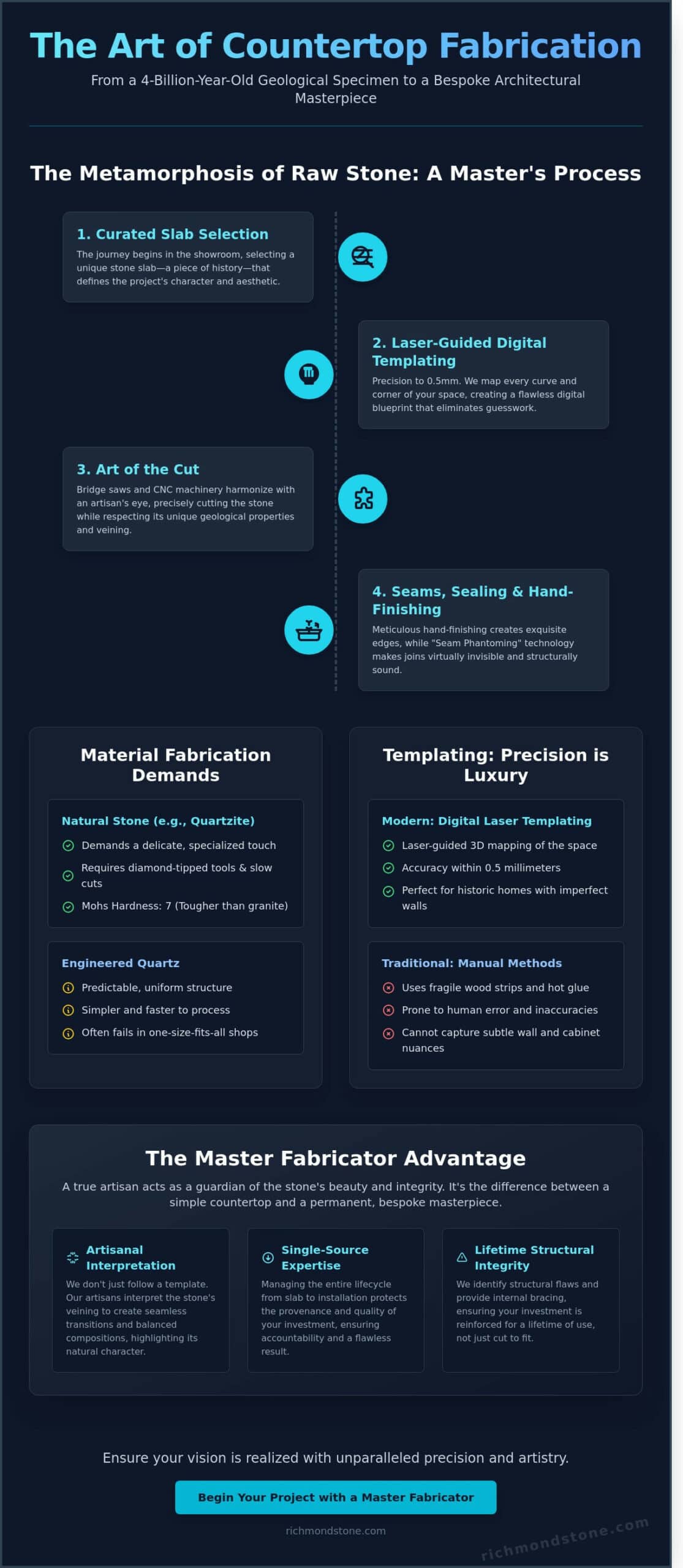
True countertop fabrication is the bespoke process of transforming raw, geological slabs into finished architectural surfaces. It’s a journey that begins with the selection of a unique specimen and ends with a permanent installation in a refined home. This metamorphosis is far more than simple cutting; it’s a comprehensive lifecycle that demands technical precision and an artistic eye. While the industry often focuses on the utility of countertop materials and fabrication techniques, the Richmond Stone approach prioritizes the emotional value of nature refined by hand. We believe a kitchen island or vanity isn’t just a workspace. It’s a piece of history, millions of years in the making, meticulously tailored for the modern home.
The timeline of this transformation is deliberate. It starts within the curated aisles of our Staten Island showroom, where clients select the exact slab that speaks to their aesthetic. From there, the stone moves through a rigorous process of digital templating and precision engineering before the final NYC installation. This structured progression ensures that the finished product isn’t just a surface, but a legacy piece that mirrors the permanence and stability of the stone itself.
The Role of the Fabricator as an Artisan
A master fabricator acts as a guardian of the stone’s intrinsic beauty. Their primary responsibility involves identifying structural flaws that could compromise integrity while simultaneously highlighting “beauty marks” that define the slab’s character. Understanding stone provenance is vital; a block of Calacatta marble from Carrara requires a vastly different fabrication approach than a slab of Brazilian granite. This deep knowledge of material heritage is why we invite clients to explore custom countertops Staten Island as the essential foundation for any high-end project. Our artisans don’t just follow a template; they interpret the stone’s veining to create seamless transitions and balanced compositions.
Natural Stone vs. Engineered Quartz Fabrication
The technical requirements for countertop fabrication vary significantly based on the chosen material. Natural stones like marble and quartzite demand a delicate, highly specialized touch. Quartzite, for instance, ranks at a 7 on the Mohs hardness scale, making it significantly tougher than granite. Because of this density, quartzite countertops require specialized diamond-tipped tools and significantly slower cutting speeds to prevent chipping or overheating. In contrast, engineered quartz offers a more predictable, uniform structure that’s easier to process. One-size-fits-all fabrication shops often fail with exotic natural materials because they don’t adjust their machinery or timing for these nuances. We treat every slab as an individual, ensuring the cutting and polishing speeds respect the stone’s unique physical properties. For homeowners drawn to softer natural materials with a developing patina, soapstone countertops present a uniquely compelling alternative that demands its own specialized fabrication approach.
The Precision of the Digital Template: Mapping Your Vision
Every architectural masterpiece begins with an exacting plan. In the sophisticated world of countertop fabrication, the digital template serves as the definitive blueprint. It captures the unique soul of your space, especially in the historic brownstones of New York City or the refined estates of New Jersey where walls are rarely perfectly plumb. This phase is not merely about measurement; it is about translating the physical reality of your home into a digital landscape that our artisans can refine with absolute certainty.
We have moved beyond the era of fragile wood strips and hot glue. Today, Richmond Stone employs laser-guided technology to map every curve and corner. This digital “skin” accounts for the subtle nuances of your cabinetry, the specific overhangs required for comfortable seating, and the seamless integration of sink cutouts and backsplashes. By capturing the environment in a three dimensional space, we eliminate the guesswork that often leads to compromises during installation.
Digital Laser Templating vs. Manual Methods
Precision is the hallmark of true luxury. Our digital systems capture measurements with an accuracy within 0.5 millimeters, a standard that far exceeds traditional manual methods. These digital files translate directly to our CNC machinery, removing the risk of human error that often plagues less sophisticated operations. Following the Natural Stone Institute guidelines, we ensure that every cut respects the structural integrity of the stone. This meticulous approach is why Richmond Stone insists on digital templating for every bespoke project we undertake. It provides the peace of mind that your investment will fit perfectly the first time.
The Aesthetic Layout: Vein Matching and Flow
Beyond technical fit, we focus on the visual narrative of the stone. Using Slabsmith technology, we photograph your chosen slab in high resolution and overlay the digital template onto the image. This allows you to witness exactly how a specific movement of quartz or a cluster of minerals will sit on your kitchen island before a single cut is made. For those selecting rich, tonal materials like granite colors venetian gold, this stage is vital. It ensures the pattern flows naturally across seams, maintaining the stone’s inherent elegance and prestige.
This digital rehearsal allows us to manipulate the layout to highlight the most exquisite features of the slab. We treat the stone as a canvas, ensuring that the natural artistry created over millennia is displayed to its best advantage in your home. You can explore our design philosophy to see how this digital foresight results in a finished piece that feels like a single, cohesive work of art rather than a collection of separate parts.
The Art of the Cut: Technology Meets Hand-Finishing
The journey of countertop fabrication transitions from the raw earth to the refined home through a delicate balance of industrial power and human sensitivity. We begin by utilizing high-pressure waterjets and five-axis bridge saws to execute the initial rough cuts. These machines use a stream of water pressurized to 60,000 PSI or diamond-tipped blades to carve through dense granite and quartzite with surgical intent. This stage ensures the slab is sized correctly while respecting the natural flow of the stone’s veining, preserving the inherent story within the material.
CNC Machining: The Foundation of Precision
Digital accuracy defines the modern standard for luxury surfaces. Our CNC (Computer Numerical Control) routers translate architectural blueprints into physical reality with tolerances often tighter than 0.5 millimeters. This technology is essential for creating the undermount sink cutout, a feature that requires absolute verticality and a perfectly smooth internal radius to prevent structural stress. Leading quartz countertop fabricators utilize these automated systems to achieve the uniform, crisp edges that define a contemporary kitchen. Whether we are carving a complex ogee profile or a simple eased edge, the CNC provides a level of consistency that manual tools cannot sustain across a 10-foot span.
The Artisan’s Touch: Hand-Polishing and Final Detailing
While machines provide the geometry, our master artisans provide the soul. The final 5% of the countertop fabrication process is performed entirely by hand, as this is where the prestige of the finish is truly born. A machine cannot feel the subtle “bird pecks” or micro-fissures that are inherent to natural marble or granite. Our craftsmen use a series of diamond polishing pads, moving from 50-grit to 3,000-grit, to coax a mirror-like luster from the stone. It’s a tactile process that relies on decades of experience to master.
Before any piece leaves our facility, it undergoes a rigorous “Dry Fit” process. We assemble the entire project on our shop floor to ensure that every seam aligns perfectly and the veining flows across the transitions. This meticulous step prevents unforeseen issues during installation and guarantees a bespoke result. Our clients choose from a curated selection of edge profiles to define their aesthetic:
- Eased Edge: A clean, timeless look with slightly softened corners for a modern feel.
- Ogee: A classic S-shaped curve that evokes traditional elegance and heritage.
- Mitered Apron: Creating the illusion of a massive, thick slab through expert 45-degree joins.
- Bullnose: A fully rounded edge that offers a soft, tactile experience and safety in high-traffic areas.
This intersection of technology and tradition ensures that every surface is not just a product, but a curated masterpiece. By blending the tireless precision of the CNC with the discerning eye of the artisan, we create environments that feel both ancient and contemporary.
Strength, Seams, and Sealing: Ensuring Longevity
The integrity of a stone surface isn’t merely found in its geological hardness; it lives in the meticulous details of its assembly. While the raw beauty of a slab captures the imagination, the technical precision of countertop fabrication ensures that beauty survives the rigors of a high-traffic kitchen. Homeowners often approach the design process with a singular, pressing anxiety: the visibility of the seams. At Richmond Stone, we view a seam not as a necessary evil, but as an opportunity to demonstrate the master artisan’s touch. We employ Seam Phantoming technology to ensure every joint is a testament to our quiet confidence and technical authority.
The Science of the Invisible Seam
Achieving a flawless transition requires more than a steady hand. We utilize high-performance, color-matched epoxy resins that bond the stone chemically and visually. These resins are custom-tinted to match the unique provenance of your specific slab, ensuring the 1/16th-inch join becomes nearly imperceptible. To achieve this level of precision, our installers use Gorilla Grip vacuum-seam setters. These industrial tools apply consistent, high-pressure tension to pull the slabs together, eliminating lippage and creating a perfectly level surface. In bespoke kitchens featuring dramatic movement, our fabricators prioritize vein matching. By aligning the natural flow of the stone across the break, the seam disappears into the organic artistry of the material itself.
Reinforcement and Structural Integrity
True luxury is built to last for generations. To prevent the stress cracks that often plague inferior installations, we implement a process known as rodding. This involves embedding high-strength steel or fiberglass bars into 3/8-inch grooves on the underside of the stone. This reinforcement is essential for fragile areas, such as the narrow strips of stone surrounding a sink cutout or across long-span islands. These hidden supports absorb the tension that natural stone cannot handle alone. Every piece that leaves our facility must pass a rigorous quality control checklist, ensuring 100% of our surfaces meet the Richmond Stone standard for structural excellence. This commitment to “nature refined by hand” protects your investment against the subtle shifts of a home’s foundation over time.
The final stage of our countertop fabrication process involves the application of professional-grade penetrating sealers. Unlike topical coatings that sit on the surface, these specialized formulas bond within the pores of the stone to provide a 15-year shield against permanent etching and staining. This invisible barrier preserves the stone’s breathability while ensuring that oils and acids don’t mar its exquisite finish. It’s a final, protective embrace for a material that has spent millennia in the earth, now ready for its new life in your home. Clients who prefer a surface that develops character over time rather than resisting every mark often find that soapstone countertops for NYC homes offer a compelling alternative, as their unique mineral density requires a distinctly different sealing philosophy.
Experience the difference that master-level craftsmanship makes in your next project. Schedule a consultation with Richmond Stone to begin your journey toward a timeless interior.
The Master Fabricator Advantage: Why Single-Source Expertise Matters
Choosing the right partner for countertop fabrication is as critical as the stone itself. Many homeowners fall into the trap of fragmented procurement. They source a slab from a distant wholesaler, hire an independent cutter, and rely on a third-party contractor for the final fit. This disjointed approach often leads to communication breakdowns, misaligned seams, or installation delays. Richmond Stone eliminates these risks by acting as a single-source partner. Since our family established this legacy in 1994, we’ve remained a pillar of the industry, overseeing every stage of the journey from the raw block to the finished architectural element.
Our 30-year history provides a level of stability that newer, smaller shops can’t match. We don’t just cut stone; we curate an experience. By maintaining control over the entire supply chain, we ensure that the exquisite veining you fell in love with at the start is the same pattern that graces your kitchen at the end. This continuity is the hallmark of a master artisan. For discerning homeowners who want to understand exactly what to look for when searching for countertop fabrication near me, the distinction between a simple supplier and a true master artisan is the single most important factor in protecting a significant investment.
Accountability from Slab to Sink
A single point of contact ensures that your design vision remains intact through every phase. Our master-led team manages the entire countertop fabrication process, which means there’s no room for the blame-shifting that often plagues multi-vendor projects. We provide a “White Glove” installation service specifically designed to protect your residence. Our technicians treat your home with the same reverence we show the stone, ensuring a clean, precise, and respectful final phase. It’s about peace of mind. You aren’t just buying a surface; you’re securing a commitment to excellence that will last for decades.
Serving the NYC Metro and New Jersey Area
Managing the logistical demands of the tri-state area requires local mastery. Whether we’re delivering to a historic Brooklyn brownstone or a sprawling estate in New Jersey, our team understands the specific challenges of urban and suburban logistics. We know the narrow streets of Staten Island and the strict delivery windows of Manhattan luxury towers. To complete your bespoke vision, we offer custom cabinetry and artisanal tile selections that harmonize with your chosen slab. This holistic approach transforms a simple renovation into a curated masterpiece that feels both ancient and contemporary.
Experience the intersection of nature and human skill. We invite you to visit our Staten Island showroom for a personal consultation. See firsthand how we refine raw beauty into a timeless environment that reflects your unique prestige.
Crafting a Legacy in Every Detail
The journey from raw earth to a finished architectural masterpiece requires more than just machinery; it demands a marriage of digital precision and artisanal intuition. You’ve seen how the evolution of countertop fabrication now relies on state-of-the-art digital templating to eliminate error, followed by the meticulous touch of a master’s hand to bring out the stone’s natural soul. By prioritizing single-source expertise, you ensure that the integrity of your material is preserved from the first cut to the final seal.
Richmond Stone has spent over 30 years refining this delicate balance. As a family-owned pillar of craftsmanship, we combine CNC precision with the wisdom of three decades of experience. We’re proud to serve homeowners and architects across all NYC boroughs and the New Jersey Metro area, transforming raw provenance into bespoke reality. Your home deserves a centerpiece that transcends fleeting trends to become a permanent part of your history.
Experience the Richmond Stone difference; schedule your bespoke design consultation today.
We look forward to helping you select a stone that tells your unique story for generations to come.
Frequently Asked Questions
How long does the countertop fabrication process typically take?
The countertop fabrication process typically requires seven to ten business days from the moment we finalize your digital templates to the day of installation. This timeframe allows our artisans to execute precise cuts and hand-finished edges with the meticulous care your stone deserves. While larger projects involving complex mitering might extend this period to 14 days, we prioritize a measured pace to ensure the structural integrity of every slab remains uncompromised.
What is the difference between a stone supplier and a stone fabricator?
A stone supplier acts as a gallery where you select raw slabs, whereas a stone fabricator’s the master artisan who transforms that raw material into your finished architectural element. Suppliers manage the global sourcing and provenance of the stone. Fabricators take responsibility for the technical execution, including laser templating, waterjet cutting, and the final installation within your home. Richmond Stone bridges these roles to provide a seamless, bespoke experience from selection to completion.
Can I choose which part of the slab is used for my island?
You possess the creative freedom to select the specific veining and character of the slab for your island during our digital layout process. We utilize high-resolution imagery to map the template onto your chosen stone, ensuring that 100% of the natural focal points align with your vision. This collaboration allows you to highlight exquisite mineral deposits or specific patterns, ensuring the final piece serves as a curated masterpiece within your kitchen.
Are seams always necessary in large kitchen countertops?
Seams become necessary when a surface exceeds the natural dimensions of a slab, which typically averages 115 to 130 inches in length. In 85% of large scale kitchen designs, strategic seam placement ensures structural stability and allows for safe transport into your residence. We employ precision book-matching techniques to ensure these joins remain nearly invisible, preserving the continuous, fluid movement of the stone’s natural artistry across your entire workspace.
Why is fabrication more expensive for certain stones like quartzite or marble?
Natural stones like quartzite and marble demand specialized handling due to their unique physical properties and mineral density. Quartzite ranks as a 7 on the Mohs hardness scale, requiring diamond-tipped tools and 40% more time to cut than softer stones. Marble requires a delicate, expert touch to prevent fracturing during the intricate countertop fabrication process. These materials necessitate a higher level of craftsmanship to refine their raw beauty into a durable, timeless surface.
What should I look for when choosing a countertop fabricator in NYC?
Select a partner with a deep understanding of New York City’s unique logistical challenges, including COI requirements and tight freight elevator dimensions. A reputable NYC fabricator should provide a portfolio showcasing at least 10 years of local installations and hold membership in the Natural Stone Institute. Look for artisans who emphasize bespoke service and possess the specialized equipment necessary to handle the high-performance materials required for luxury urban living. Our guide to finding trusted countertop fabrication near me in NYC and NJ outlines the precise criteria that separate a master craftsman from a generic workshop.
Is sealing included in the fabrication and installation price?
We include professional-grade sealing as a standard final step for all porous natural stones during the installation phase. This protective treatment serves as a vital barrier, preserving the stone’s provenance against daily use while maintaining its luminous finish. For materials like granite or marble, we apply a high-performance impregnating sealer that penetrates the surface, ensuring your investment remains a timeless centerpiece for years to come without immediate maintenance concerns.
Do I need to be present during the templating process?
Your presence’s required during the 90-minute templating session to confirm critical details such as seam locations, overhang depths, and edge profiles. This collaborative phase ensures the countertop fabrication aligns perfectly with your cabinetry and appliance specifications. By participating in this technical walkthrough, you provide the final approval necessary for our artisans to begin the meticulous work of refining your selected stone into its finished architectural form.