
Grey Quartz Countertops for Modern Kitchens: A Guide
The grey that feels calm beneath a showroom’s bright lights can look unexpectedly cool or warm in your kitchen. That’s why choosing grey quartz countertops for modern kitchens takes more than matching a sample to a cabinet door. Natural and artificial light, undertones, veining, and surrounding finishes all shape the finished impression.
A surface should suit your design and your everyday expectations. To avoid finding out after installation that the pattern competes with your backsplash or the care requirements are unclear, compare grey quartz styles in your own kitchen and consider how each option works with your cabinetry, flooring, and tile. This guide covers those choices, along with practical care and why a durable surface is not necessarily heatproof. As you narrow the options, consider the full project: material selection, templating, fabrication, edge details, and installation all affect the result. Asking specific questions about each stage can help you choose a grey tone and pattern that feels balanced in your home.
Key Takeaways
- Grey quartz countertops for modern kitchens range from pale, understated tones to charcoal designs with pronounced veining. Compare the overall pattern as well as the shade.
- Use the cabinet-pairing guide to consider how light grey, mid-grey, and charcoal surfaces may complement white cabinetry, wood tones, or lighter finishes.
- View shortlisted samples in your kitchen before choosing, and ask how the selected product’s care guidance applies to everyday use.
- Discuss edge details, seams, cutouts, and installation planning with your fabricator so the finished countertop suits the room and its intended use.
- Richmond Stone connects quartz sourcing, templating, custom fabrication, and professional installation for homeowners in Staten Island, New York City, and the New Jersey metro area.
Grey quartz countertops for modern kitchens: what makes each look distinct?
Grey quartz countertops for modern kitchens can look quietly refined, softly warm, or boldly architectural. The shade is only one part of the decision. Undertone, pattern, finish, and the light around the surface all contribute to its appearance.
Engineered quartz is a manufactured surface made by combining mineral material with resin. Unlike natural stone, it is formed through production rather than quarried as a single slab with naturally occurring patterns. Composition and appearance vary by product. For a concise overview of engineered stone, see the material category that includes quartz surfaces. The examples below are design directions, not claims about specific Richmond Stone collections or current selections.
For a visual example of grey quartz used in an industrial-style kitchen, watch:
Which grey quartz styles suit a modern kitchen?
Grey ranges from cool to warm and pale to charcoal, with patterns from subtle movement to conspicuous veining. Pale grey with low contrast can create a light, composed feel alongside minimal cabinetry and clean-lined layouts. Mid-grey has more presence and can balance wood tones. Charcoal creates a deeper, more graphic effect against lighter finishes.
A visibly veined design can become the room’s focal point, drawing the eye across an island or countertop run. Not every product has pronounced veining, and a dramatic pattern may compete with patterned tile or strongly grained cabinetry. Decide how much visual attention you want the counter to draw, then compare samples with the other finishes in the room.
What does grey quartz look like in different lighting?
Light changes how undertones and depth appear. Direct daylight can reveal contrast and surface movement, while lower-intensity light may make grey look deeper. The direction of daylight matters, too. Cooler light may emphasize cool notes, while warmer light can bring out beige or taupe qualities. These are visual tendencies, not universal product specifications.
Assess samples in context. Place them beside your cabinetry, flooring, and backsplash, and view them at different times of day under the kitchen’s usual lights. A sample that looks balanced on its own may appear cooler, warmer, lighter, or more dramatic when surrounded by the room’s finishes. Choose based on how the sample looks in your kitchen, not only under showroom lighting.
How undertones, veining, and kitchen light shape grey quartz
A grey surface can lean blue, green, or beige, or appear nearly neutral. Those subtle shifts affect how it relates to the rest of the kitchen. Warm and cool describe visual tendencies, not universal specifications: the same label may look different across products and in different rooms. When comparing grey quartz countertops for modern kitchens, assess each sample beside the finishes it will live with and under the light in your space.
How can you identify a grey quartz undertone?
Compare samples against fixed references, such as a white cabinet door, a warm-neutral finish, and a dark cabinet or tile. Notice whether the grey appears distinctly blue or green, takes on a beige cast, or stays relatively balanced. Look at it beside your actual cabinetry rather than judging it alone.
A countertop sample reveals its character most clearly beside the fixed finishes it will live with. View it in the kitchen under daylight and the artificial lighting you use in the evening. Daylight direction and intensity can change perceived warmth and depth, while lamps can shift the impression again. Online photos can help narrow options, but screens, lighting, and photography can alter colour, so don’t rely on them for a final decision.
How should veining work with cabinets and backsplashes?
Veining affects how much visual weight the counter carries. Fine, low-contrast movement tends to recede, allowing cabinetry, hardware, or lighting to lead. Larger, higher-contrast veins draw attention and can create a focal point, particularly across an island. Pair a strongly patterned surface with simpler cabinet fronts or a quieter backsplash to avoid competing lines.
Consider pattern scale in relation to the room. Broad veining may feel deliberate on a generous island, while a dense pattern can look busy beside narrow cabinet details or a highly active backsplash. Before selecting a product, view the sample with the full group of finishes and consider how seams and edges could affect the pattern’s visual flow.
Quartz is made using mineral material, but countertop composition and performance vary by product. Geology.com describes natural quartz as an abundant mineral in Earth’s crust; that background is not a guarantee of finished-surface performance. For broader guidance on coordinating kitchen finishes, explore 2026 kitchen remodel ideas, then discuss product-specific samples and details with a fabricator.
Grey quartz countertop examples compared by kitchen style and use
Start by comparing how the counter relates to the room, rather than choosing by shade name alone. These pairings are illustrative design guidance, not confirmation of Richmond Stone inventory or current sample availability. Use them to shortlist grey quartz countertops for modern kitchens, then assess the specific product and its manufacturer’s care guidance separately from its appearance.
| Look | Cabinet pairing | Visual effect | Sample-check advice |
|---|---|---|---|
| Pale grey, restrained pattern | White cabinetry | Soft contrast that lends definition without making the counter the focal point. | Compare it with the cabinet white; check whether the grey reads blue, green, or warm beside it. |
| Mid-grey, subtle movement | Wood tones | A composed balance between the counter’s coolness or warmth and the grain of the cabinetry. | Look for competing undertones. Check the sample beside the actual wood finish in kitchen lighting. |
| Charcoal or pronounced veining | Lighter cabinets and finishes | Higher contrast and a more graphic, attention-drawing surface. | View it in both brighter and dimmer parts of the room to judge its depth and pattern clearly. |
Which grey quartz works with white, wood, or dark cabinets?
With white cabinetry, pale grey can create a gentler transition than a stark white-on-white scheme while keeping the overall impression light. Beside wood, mid-grey offers a clear counterpoint, but check whether the wood’s golden or reddish cast works with the sample’s undertone. Charcoal creates stronger contrast against lighter finishes. If your kitchen has limited natural light, review a charcoal sample carefully to judge whether the darker surface feels too visually heavy for the room.
Should you choose subtle grey or a statement pattern?
Let the room’s existing details guide the pattern. If flooring, cabinetry, or a backsplash already has strong grain, texture, or movement, a quieter grey can balance the composition. Expressive veining suits a counter intended to draw the eye, especially when surrounding finishes are simpler. Consider the island’s scale and the cabinet lines, too: a broad pattern may read differently across a large surface than on a short counter run.
Style and care are separate decisions. Ask for the selected product’s manufacturer guidance, including cleaning recommendations and heat precautions. Don’t assume that every grey quartz surface has the same care requirements. For broader project context, see the custom countertop artisan guide. If you’re considering natural stone elsewhere in the kitchen, the Natural Stone Institute standards offer a reference for that material category; they are not product specifications for engineered quartz. Richmond Stone can discuss quartz sourcing and fabrication as part of a kitchen countertop project; learn more at Richmond Stone’s countertop services.

How to assess grey quartz samples, care, and fabrication before choosing
A sample helps you judge colour and pattern, but your decision should also account for product-specific care and the details that shape the finished counter. Use this checklist before committing to grey quartz countertops for modern kitchens.
- Shortlist by appearance. Compare a few options for tone, veining, and finish against your kitchen’s fixed materials.
- View samples in the room. Check each sample vertically and horizontally beside actual cabinetry, flooring, and backsplash materials. Ask whether a larger sample or slab viewing is available for the selected material. Compare it under daylight and your usual artificial lighting.
- Confirm the exact product and care guidance. Before approval, verify the product and finish, then request the manufacturer’s care and heat instructions. Guidance can vary by product, so follow the documentation for the surface you select.
- Review fabrication details. Discuss the edge profile, seam placement, sink cutouts, and how the layout will work across the countertop and any island. Ask how the pattern will meet at seams and what details could affect its visual flow.
- Plan installation. Confirm how templating, delivery, and installation are coordinated. Discuss kitchen access, cabinetry readiness, and project sequencing before fabrication begins.
Everyday durability doesn’t mean a quartz countertop is heatproof. Ask the manufacturer what precautions apply, and follow its instructions rather than assuming the surface can tolerate direct heat.
What should you check before approving a quartz sample?
Look at the sample upright, as it may appear against a backsplash, and flat, as it will on the counter. A small piece can suggest the colour, but may not show how a larger pattern repeats. Ask whether a larger sample or slab viewing is possible, and check that the product name, finish, and care documentation match what you’re approving.
What should a fabricator clarify about templating and installation?
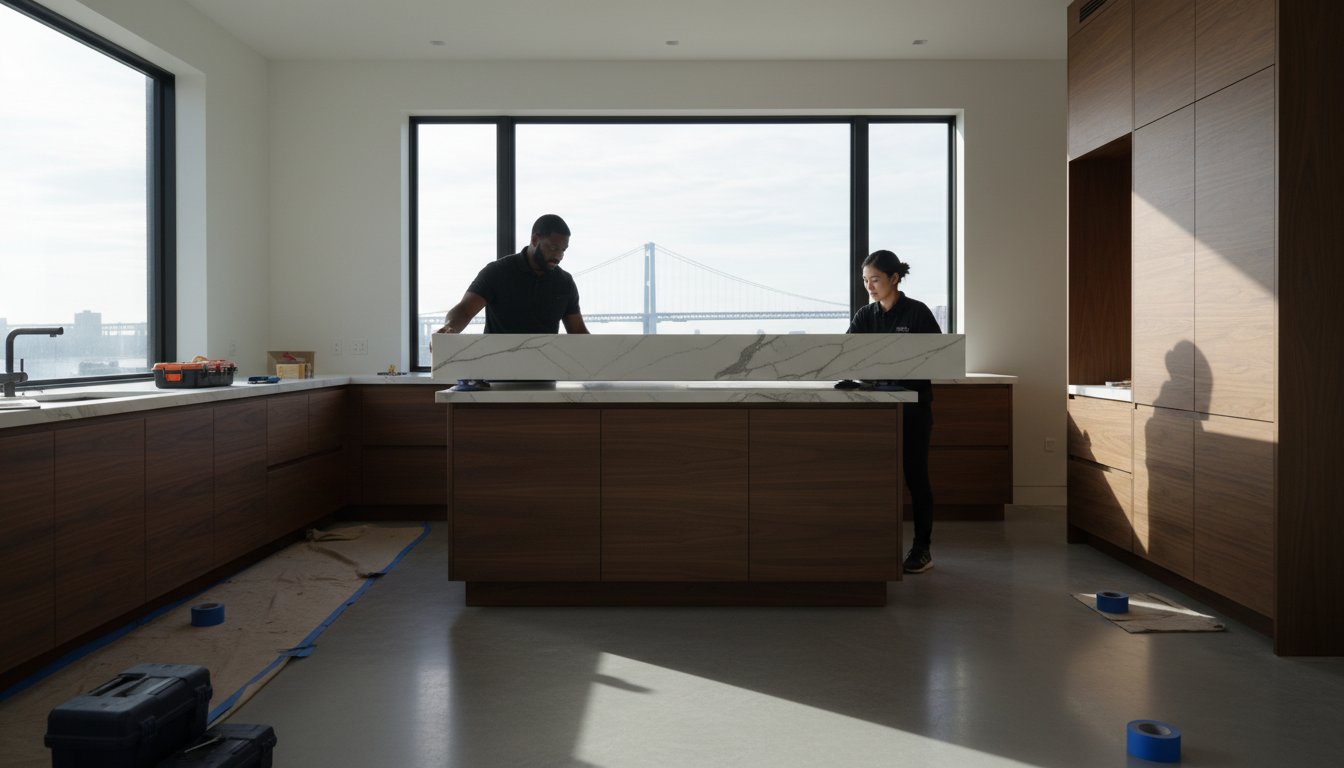
Templating translates the kitchen’s actual dimensions into a fabrication plan, so clarify when it happens and whether cabinetry must be ready beforehand. Review sink cutouts, seams, edge details, access, delivery, and installation sequencing together instead of treating them as separate afterthoughts. For more on the craft and planning involved, read this quartz fabrication guide for NYC.
For a project that connects quartz sourcing, templating, fabrication, and professional installation, discuss your countertop project with Richmond Stone.
Plan grey quartz countertops with Richmond Stone in Staten Island and NYC
Choosing grey quartz countertops for modern kitchens is one part of a larger project. Material selection, room measurements, fabrication details, and installation all need to come together. Richmond Stone is a family-owned countertop, cabinetry, and tile business with more than 30 years of experience, serving Staten Island, New York City boroughs, and the New Jersey metro area.
Richmond Stone’s process connects material sourcing, templating, custom fabrication, and professional installation. Each stage helps translate a design choice into a finished countertop suited to the kitchen’s layout. Grey quartz options and sample availability can change, so confirm what is available for your project rather than relying on a product name or image alone.
What can homeowners discuss during a countertop project?
Bring cabinet, flooring, backsplash, and lighting references to the material-selection conversation. These details make it easier to assess whether a grey sample’s undertone and pattern work with the finishes already planned. Ask about current options and sample availability, and confirm the selected product and its manufacturer’s care guidance before approval.
Clarify the project scope at the same time. Share your preferred edge, sink and other cutouts, and any island or counter layout considerations. Ask how templating, fabrication, and installation are coordinated, what needs to be ready before templating, and what access or scheduling details the team needs to know. Addressing these questions early helps keep design and project decisions connected.
How can a local fabricator help bring the design together?
Templating records the kitchen’s dimensions and relevant layout details so the countertop can be fabricated for the space. That plan informs cutouts, edge treatment, and seam placement, where applicable. Review these choices with the fabricator before fabrication begins so you can discuss how the selected material and its pattern will look across the finished surface.
Richmond Stone’s service sequence brings sourcing, templating, custom fabrication, and professional installation into one project pathway. For homeowners in its service area, discussing cabinet finishes, samples, and kitchen requirements with the team can help establish the next steps. To begin, discuss a grey quartz countertop project with Richmond Stone.
Make Your Grey Quartz Choice With Confidence
The right grey quartz surface is more than a shade that looks appealing on a sample. Consider its undertone in your kitchen’s light, how its veining relates to the cabinetry and backsplash, and whether its care guidance suits your everyday use. Review samples beside your fixed finishes, then discuss edges, seams, cutouts, and installation planning before approval.
For grey quartz countertops for modern kitchens, thoughtful selection and careful fabrication help bring the design together. Richmond Stone is family-owned and operated, with more than 30 years of experience. Its process includes quartz sourcing, templating, custom fabrication, and professional installation for homeowners across Staten Island, New York City boroughs, and the New Jersey metro area.
Bring your cabinet, flooring, backsplash, and lighting references to the conversation, and ask about current grey quartz options and sample availability. Discuss your grey quartz countertop project with Richmond Stone and take the next step toward a kitchen that feels composed and personal.
Frequently Asked Questions
Is grey quartz a good choice for a modern kitchen?
Grey quartz can suit a modern kitchen, with options ranging from quiet, tonal surfaces to designs with expressive veining. The best fit depends on your room’s light, cabinetry, flooring, and backsplash. Compare a sample with those finishes in your kitchen instead of relying on online images alone. Before choosing, confirm the selected product’s care instructions so its maintenance requirements are clear.
Do grey quartz countertops look different in natural and artificial light?
Yes. The same grey sample can appear warmer, cooler, lighter, or deeper under different lighting. Daylight direction and intensity affect how undertones and patterns read, while evening lighting can shift the impression again. Place a sample beside your cabinets and flooring, then view it at different times of day. This gives you a more useful reference than showroom lighting or a screen.
What cabinet colours go with grey quartz countertops?
Grey quartz can pair with white, wood-toned, or dark cabinetry, but consider undertones and pattern before deciding. Pale grey may soften the contrast with white cabinets, while mid-grey can create a measured counterpoint to wood. Charcoal offers stronger contrast with lighter finishes. Check each sample against the actual cabinet material, then include the backsplash and flooring to assess whether the full palette feels balanced.
Is grey quartz better than grey granite for a kitchen?
Neither is automatically better; quartz and granite differ in origin, appearance, and product-specific care considerations. Quartz is manufactured, while granite is natural stone, so natural variation may be more apparent from one granite slab to another. Compare the actual surfaces rather than relying on colour names or general claims. Ask for the selected product’s maintenance guidance and consider which material’s appearance and project requirements best suit your kitchen.
Can you put hot pans on grey quartz countertops?
Don’t assume a quartz countertop is heatproof. Heat tolerance and care guidance can vary by product, and direct or sudden heat may pose a risk to the surface. Follow the manufacturer’s instructions for the exact material you select, and use a trivet as a cautious everyday habit. Before installation, ask your fabricator for the product’s written care documentation so you know what precautions the manufacturer recommends.
Do grey quartz countertops need to be sealed?
Check the manufacturer’s instructions for the specific quartz surface instead of assuming all countertops have the same sealing requirements. Ask for written guidance on cleaning, spills, and routine care before approving the product. The selected surface’s documentation is the best reference for maintenance. If anything is unclear, ask the fabricator to help identify the appropriate product information before installation.
How do I choose between light grey and charcoal quartz?
Start with your kitchen’s natural and artificial light, then compare samples beside cabinetry, flooring, and backsplash finishes. Light grey often creates a quieter, softer impression, while charcoal tends to make a stronger visual statement. Pattern matters, too: a high-contrast design can feel more prominent than a restrained one. View samples in the room and discuss your preferred look and product details with the fabricator before making a final selection.
Can Richmond Stone help with grey quartz countertop fabrication and installation in NYC?
Yes. Richmond Stone offers quartz countertops and provides sourcing, templating, fabrication, and professional installation. The family-owned business serves Staten Island, all New York City boroughs, and the New Jersey metro area. Contact the team to discuss your kitchen’s requirements and confirm current grey quartz options and sample availability. Ask how the stages of your project will be coordinated, from material selection through installation.